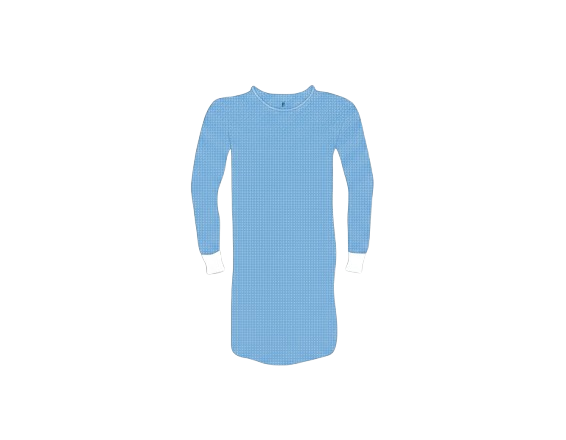
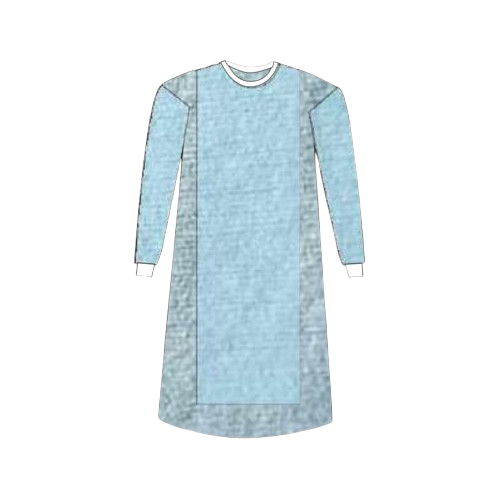
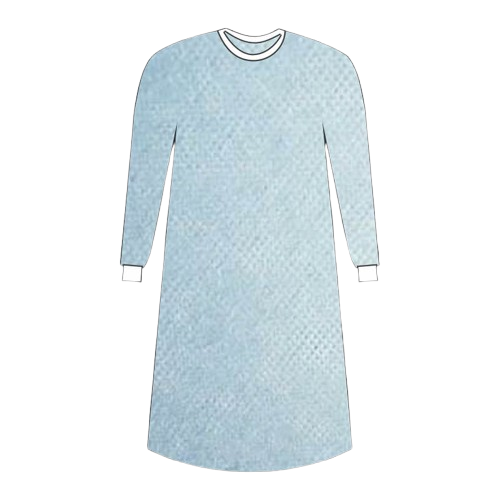
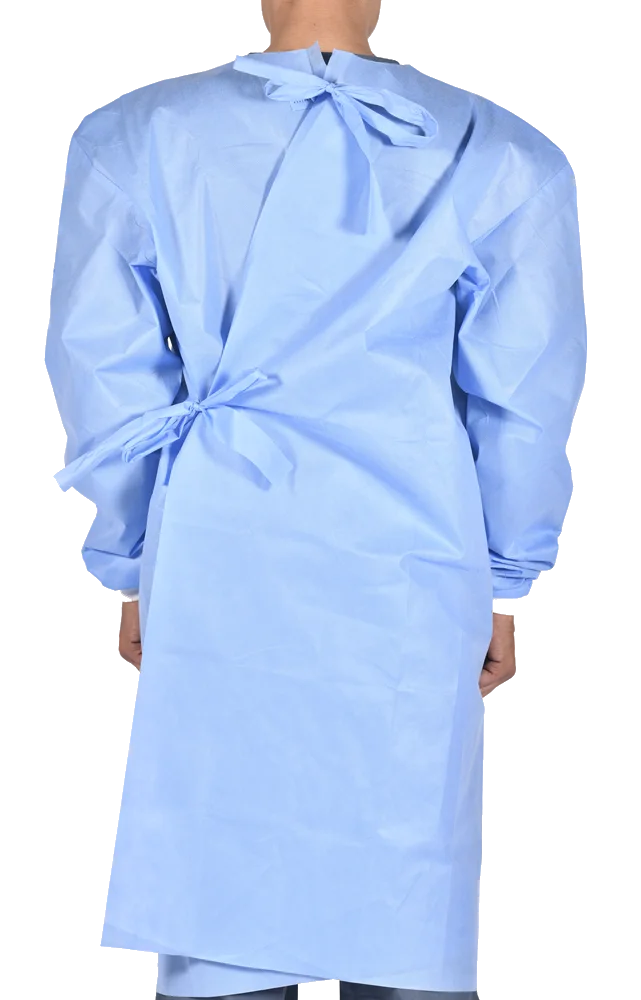
Key takeaways
- Sterility and barrier level are independent: one concerns freedom from viable micro-organisms, the other resistance to liquid.
- A sterile gown is identified by its individually sealed pack, the sterile symbol with method, a use-by date and an intact barrier.
- Sterile gowns are for work within a sterile field and invasive procedures; non-sterile gowns are for isolation, visitor and patient use.
- Requisitions and tenders should state sterility and barrier level as separate requirements.
Requisitions often ask for “sterile gowns” when what the ward needs is fluid protection, or for “Level 3 gowns” when the theatre assumes that sterility is implied. The two descriptions are not interchangeable. One says whether the garment is free of viable micro-organisms when the pack is opened. The other says how well the garment resists liquid. A gown can have either property without the other, and ordering the wrong combination wastes money or, worse, leaves a gap in protection.
Two properties that are easily confused
Sterility is a state achieved by a validated sterilisation process and maintained by packaging until the point of use. Its purpose is to protect the patient: a sterile gown can enter a sterile field without bringing micro-organisms to the wound.
Barrier level is a property of the fabric and seams, established by laboratory testing against a standard such as ANSI/AAMI PB70, EN 13795-1 or IS 17334:2019. Its purpose is to stop liquid, and what it carries, passing through the garment in either direction. The levels are explained in our guide to AAMI PB70 Levels 1–4.
Because they are independent, four combinations exist:
- sterile with a higher barrier — a reinforced surgical gown for long, wet procedures;
- sterile with a lower barrier — a standard surgical gown for short procedures with little fluid;
- non-sterile with a higher barrier — an impervious isolation gown for heavy splash exposure;
- non-sterile with a lower barrier — a visitor or cover gown.
Sterilising a gown does not improve its resistance to fluid, and a high barrier level does not make a gown fit for a sterile field.
What makes a gown sterile
A sterile gown is one that has been made under controlled conditions, sealed in a sterile barrier system, exposed to a validated sterilisation process, and released only after that process has been confirmed. For single-use non-woven gowns the usual methods are ethylene oxide gas, validated under ISO 11135, and irradiation, validated under ISO 11137. Our article on ethylene oxide sterilisation describes the first of these.
The packaging is part of the product. ISO 11607 sets requirements for the materials and sealing of sterile barrier systems, and a sterile gown is normally supplied folded for aseptic presentation inside an inner wrap, sealed in a peelable pouch that an unscrubbed person can open without touching the contents. Sterility is conditional on that pack remaining intact, dry and within its expiry date.
Telling them apart from the pack and label
The quickest way to know what is in hand is to read the label and look at how the item is packed.
| Feature | Sterile gown | Non-sterile gown |
|---|---|---|
| Unit packaging | Individually sealed peel pouch, often with an inner wrap | Folded in a polybag, commonly several to a bag |
| Sterility marking | “STERILE” symbol with the method, for example EO or R | No sterile symbol; may be marked non-sterile |
| Process indicator | Colour-change indicator on the pack showing it has been through a cycle | None |
| Dates and lot | Lot number, date of manufacture and use-by date | Lot number and date of manufacture; an expiry date may or may not appear |
| Fold | Folded so the wearer touches only the inside | Simple flat fold |
| Opening | Opened aseptically by an assistant | Taken from the bag by the wearer |
The symbols themselves are standardised in ISO 15223-1. Our guide on how to read a sterile medical-device label goes through them one by one. Two cautions apply. A process indicator shows only that the pack has been exposed to a sterilisation process, not that the contents are sterile. And a sterile label means nothing once the pack is torn, punctured, wet or past its date, so the pack must be inspected every time; storage and handling are covered in our article on sterile barrier packaging and shelf life.
Where a sterile gown is appropriate
A sterile gown is called for whenever the wearer works within a sterile field or performs an invasive procedure under full aseptic precautions. In general terms that includes:
- surgical operations, for every scrubbed member of the team;
- insertion of central venous catheters and similar lines, where maximal barrier precautions are the usual expectation;
- interventional radiology and cardiac catheterisation procedures;
- operative obstetric procedures and others designated by hospital policy.
For many minor procedures, such as suturing a simple wound, the requirement for a sterile gown varies between institutions, and local protocol decides.
Where a non-sterile gown is appropriate
Outside the sterile field, the gown exists to protect the wearer’s clothing and skin, or to keep the wearer’s clothing away from the patient. Sterility adds nothing to that purpose.
- Isolation gowns worn by staff for contact precautions and for care where splashing is expected.
- Visitor and cover gowns worn over everyday clothes in intensive care and similar units.
- Patient gowns for examination, imaging and the pre-operative period.
- Gowns for cleaning, laboratory and support tasks, where the concern is soiling.
Non-sterile does not mean dirty. These gowns should be made in clean conditions, packed to stay clean, and stored off the floor in closed cartons or dispensers. The barrier level still has to be chosen for the task: an isolation gown for a high-splash procedure needs a stated level, whereas a visitor gown does not.
Common mistakes
- Using a non-sterile gown at the sterile field because it carries a high barrier level. The level is irrelevant to sterility.
- Using sterile gowns for routine isolation. This is safe, but it uses a costlier item where its sterility serves no purpose, and each one takes longer to open.
- Assuming sterile means high barrier. A sterile standard gown may be at the lower end of the barrier range.
- Storing both types together so that they are mistaken for each other in a hurry. Separate shelves and clear bin labels prevent this.
- Trying to sterilise non-sterile gowns in the hospital. Single-use non-woven gowns are not designed for reprocessing; heat can damage polypropylene, and a hospital cycle has not been validated for the product or its packaging.
Writing it into a requisition or tender
State both properties explicitly, each in its own line. For a sterile gown: sterile, the method of sterilisation if the buyer has a preference, individually packed in a peelable sterile barrier, and the required barrier standard and level. For a non-sterile gown: non-sterile, the barrier standard and level if one is required, and the packing unit. Add size, style and fabric in the usual way.
Under India’s Medical Devices Rules 2017, sterile and non-sterile versions of a device may be treated differently for regulatory purposes, so a supplier’s licence should be checked to confirm that it covers the form being bought.
Shrisay Medical manufactures surgical, isolation, visitor and patient gowns in Faridabad, listed on our surgical gowns page and made to order in size, fabric and pack configuration.
Frequently asked questions
Does a sterile gown give more fluid protection than a non-sterile one?
Not necessarily. Sterilisation does not change barrier performance, which depends on the fabric and seams and is stated as a separate level.
Can a non-sterile isolation gown be sterilised in the hospital for theatre use?
This is not advisable. Single-use non-woven gowns are not designed for reprocessing, and a hospital cycle has not been validated for the product or its packaging.
How do I know a sterile gown is still sterile?
Check that the pack is intact, dry and within its use-by date, and that the sterile symbol and process indicator are present. If the pack is damaged or wet, treat the gown as non-sterile.