
Resistance to fluid
The fabric has to hold back blood, irrigation and prep fluids for the length of the case. Reinforced, impervious zones go where fluid concentrates.
Quality & certifications
Our operations are guided by globally recognized certifications, including ISO and other international accreditations, ensuring consistent compliance with stringent regulatory requirements.
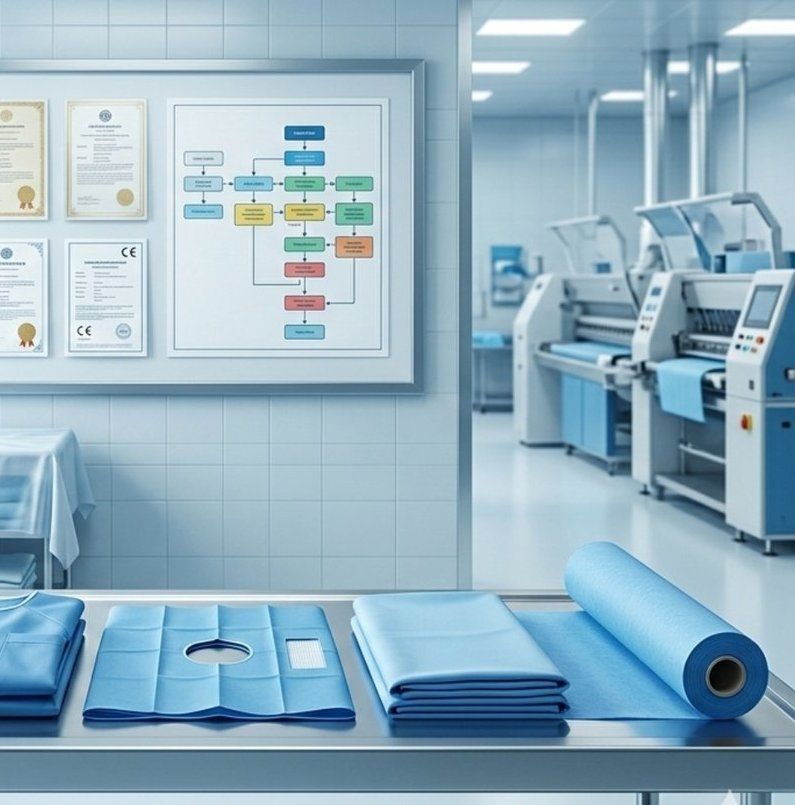
Certified manufacturing. Trusted supply.
By combining advanced materials, controlled manufacturing processes, and continuous quality checks, we provide solutions that reinforce confidence inside every operating room.
As direct manufacturers, we have full control over the production process — from the fabric that arrives at our facility in the National Capital Region to the sterile pack that leaves it.
Three inspection gates
Every order passes three gates. Each one exists to stop a specific kind of failure before it travels any further down the line.
| Gate | When | What is checked | What it prevents |
|---|---|---|---|
| Incoming material | Before a roll reaches the production floor | Fabric type and weight against the order specification; films, reinforcement and adhesive components; condition on arrival. | A problem in a roll becoming a problem in a finished pack. |
| In process | During cutting, conversion, assembly and folding | Sheet dimensions; shape and position of fenestrations; attachment of reinforcement, pouches and adhesive; gown seams, cuffs and ties; components counted against the pack list. | A defect being repeated across a whole run before anyone sees it. |
| Final release | Before the order is packed for dispatch | Finished goods against the approved sample: dimensions, construction, seal integrity, label content and pack contents. | Anything leaving the factory that does not match what was agreed. |
Barrier performance
Six properties decide whether a drape or gown does its job. They are what buyers specify, and what a standard such as IS 17334 sets out to test.
The fabric has to hold back blood, irrigation and prep fluids for the length of the case. Reinforced, impervious zones go where fluid concentrates.
Fluid that passes through a fabric can carry micro-organisms with it. Holding back fluid is how a drape or gown protects the sterile field.
A drape is pulled, clipped and leaned on. Tensile and burst strength decide whether it stays intact when it is wet and under load.
Loose fibres are a contaminant in their own right. Non-woven fabrics are chosen to shed as little as possible at the wound.
A gown worn through a long case has to breathe, and a drape has to lie flat and stay where it is placed. Fabric weight is balanced against both.
Product, size, batch details and sterility status on the pack tell the theatre team what they are opening and let a delivery be traced.
Sterility & packing
A sterile product is only as good as the pack that carries it to the operating room. Products are sealed in their unit packs, folded for aseptic opening and labelled so the theatre team knows exactly what they are handling.
Sterile products are commonly sterilised by ethylene oxide (EO). The sterility status and method for your order are confirmed in writing, and the same product can be supplied non-sterile where it will be sterilised or used differently at your end.
Registrations & recognitions
Certificates and registration documents are available on request for tenders and vendor onboarding.
Bureau of Indian Standards
Products carrying BIS certification, including underpad sheets, non-woven aprons, drape kits and cystoscopy drapes.
Central Drugs Standard Control Organisation
India’s national regulatory authority for medical devices.
Quality Council of India
The national body for quality and accreditation.

Government e Marketplace
Registered OEM supplier for government and institutional procurement.
Micro, Small & Medium Enterprises
Registered with the Ministry of MSME, Government of India.

National Small Industries Corporation
Registered for participation in government purchase programmes.

Federation of Indian Export Organisations
Member of India’s apex export promotion body.

Make in India
Designed and manufactured in India.

Startup India
Recognised under the Startup India initiative.
Catalogue products marked BIS certified
The Indian standard
BIS standards provide the reference for performance and testing of surgical drapes and gowns in India — notably IS 17334:2019 (Medical Textiles — Surgical Gowns and Surgical Drapes). The standard defines requirements for material safety, barrier performance, tensile and burst strength, and sterilization and labelling.
Compliance with these standards is a major procurement criterion for hospitals.
Read our market noteDocuments on request
Send us the document list from your tender or vendor form. We will share what applies to the products you are buying, along with your quotation.
Institutions we are proud to be associated with















Questions
What procurement and quality teams ask before they approve a supplier.
Ask on WhatsAppBIS certification is granted product by product. The catalogue products currently marked BIS certified are: Bilateral Knee-O-Drape, Cystoscopy Drapes, HIV Drape Kit, Disposable Underpad Sheets, Disposable Non-Woven Aprons. Ask us for the current list and the certificates before you quote them in a tender.
Yes. Tell us which documents your tender or vendor form lists and we will send the ones that apply with your enquiry.
Products are supplied sterile or non-sterile as ordered. Sterile products are commonly sterilised by ethylene oxide (EO); the sterility status and method are confirmed in writing with each order.
The approved sample and the agreed specification are the reference for the production run. Finished goods are checked against them — dimensions, construction, seals, labelling and pack contents — before the order is released.
It is the Indian Standard for medical textiles covering surgical gowns and surgical drapes. It sets requirements for material safety, barrier performance, tensile and burst strength, and sterilisation and labelling, and it is widely used as a procurement criterion by hospitals.
Unit packs and cartons are labelled with product, size and batch details, so a query about a delivery can be tied back to the batch it came from. Quote the batch details from the label when you contact us.
Yes. Buyers and distributors are welcome to visit the Faridabad facility by appointment.
Tell us which documents you need and our team will share them with your enquiry.