Key takeaways
- AAMI PB70 classifies gowns and drapes by liquid barrier performance in their critical zones, from Level 1 (lowest) to Level 4 (highest).
- Levels 1 to 3 are defined by water resistance tests, while Level 4 for gowns requires passing a viral penetration test.
- The right level depends on expected fluid volume, pressure on the gown and procedure duration, not on the speciality name alone.
- A gown’s level is set by its weakest critical zone component, so seams and sleeve construction matter as much as the fabric.
When a tender or a purchase requisition asks for a “Level 3 gown”, it is referring to ANSI/AAMI PB70, the American standard that classifies the liquid barrier performance of protective apparel and drapes used in healthcare. The standard is widely used well beyond the United States, including by Indian hospitals and by importers who want a simple, four-step way to describe how much fluid protection a gown offers. This guide explains what each level actually means, how the levels are tested, and how to match them to the work being done in theatre.
What AAMI PB70 measures, and what it leaves out
PB70 is concerned with one property: how well the critical zones of a gown or drape resist the penetration of liquid, and at the highest level, liquid-borne micro-organisms. It does not grade comfort, breathability, strength, linting, flammability or sterility. Those properties are covered by other standards and test methods, and a responsible specification will address them separately.
The standard works on a simple principle. Each level has defined test methods and pass criteria. A product is classified according to the lowest-performing component of its critical zone. A gown made from an excellent fabric but joined with a seam that leaks at lower pressure takes the level of the seam, not the fabric.
The four levels and their test requirements
Three laboratory tests sit behind the four levels. Water impact penetration (AATCC 42) sprays water onto the fabric and weighs how much passes through onto a blotter. Hydrostatic pressure (AATCC 127) measures the height of a water column the fabric can hold back. Viral penetration (ASTM F1671) challenges the material with a bacteriophage, Phi-X174, used as a surrogate for blood-borne viruses.
| Level | Test requirement (gowns) | Barrier described as |
|---|---|---|
| Level 1 | Water impact penetration of no more than 4.5 g | Minimal |
| Level 2 | Water impact penetration of no more than 1.0 g, and hydrostatic pressure of at least 20 cm | Low |
| Level 3 | Water impact penetration of no more than 1.0 g, and hydrostatic pressure of at least 50 cm | Moderate |
| Level 4 | Pass in the viral penetration test (ASTM F1671) | High |
For surgical drapes, the Level 4 requirement uses a synthetic blood penetration test (ASTM F1670) rather than the viral test. The standard also sets out sampling and acceptance criteria, so readers who are writing a specification should work from the current edition of the document rather than from a summary such as this one.
Matching the level to the procedure
PB70 itself classifies products; it does not tell a hospital which level to use for which operation. That decision rests with the facility’s infection control policy and the surgical team. The factors that matter are consistent, however:
- Volume of fluid — blood, irrigation fluid, amniotic fluid and other body fluids expected at the site.
- Pressure and contact — whether the surgeon leans into the field, rests forearms in a wet cavity or is exposed to spray and splash.
- Duration — a barrier that holds for twenty minutes may be challenged over four hours of continuous wet contact.
- Role — the operating surgeon and first assistant face more exposure than a circulating nurse.
With those factors in mind, the levels are commonly applied along the following lines:
- Level 1 — basic care, standard isolation, visitor cover gowns and other situations with minimal fluid risk.
- Level 2 — low-fluid tasks such as blood draws, suturing, and work in intensive care or pathology areas, and short, minimally invasive procedures with little expected fluid.
- Level 3 — the working choice for a large share of general surgery, where moderate fluid exposure is expected; also emergency and trauma settings.
- Level 4 — long, fluid-intensive procedures such as major orthopaedic, cardiovascular, trauma and obstetric surgery, and cases where a blood-borne infection is known or suspected.
These are general conventions, not rules. Hospital protocol takes precedence, and a team may reasonably choose a higher level for a particular patient or surgeon.
Critical zones: where the level applies
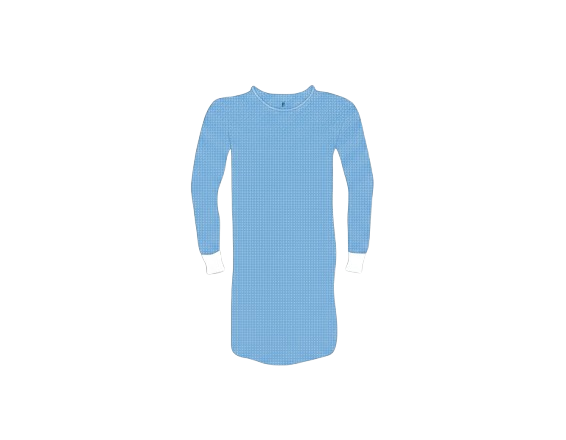
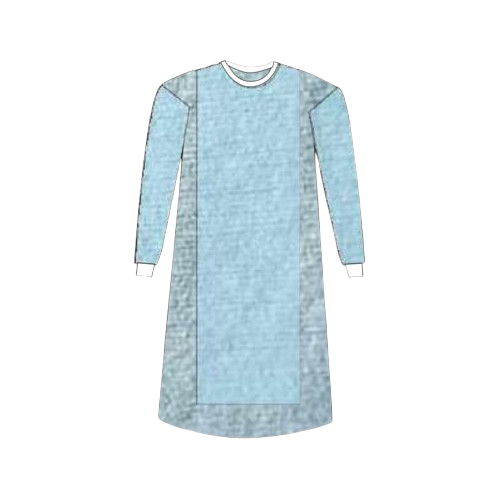
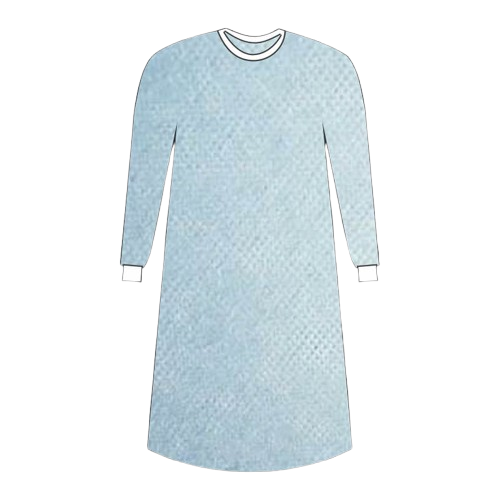
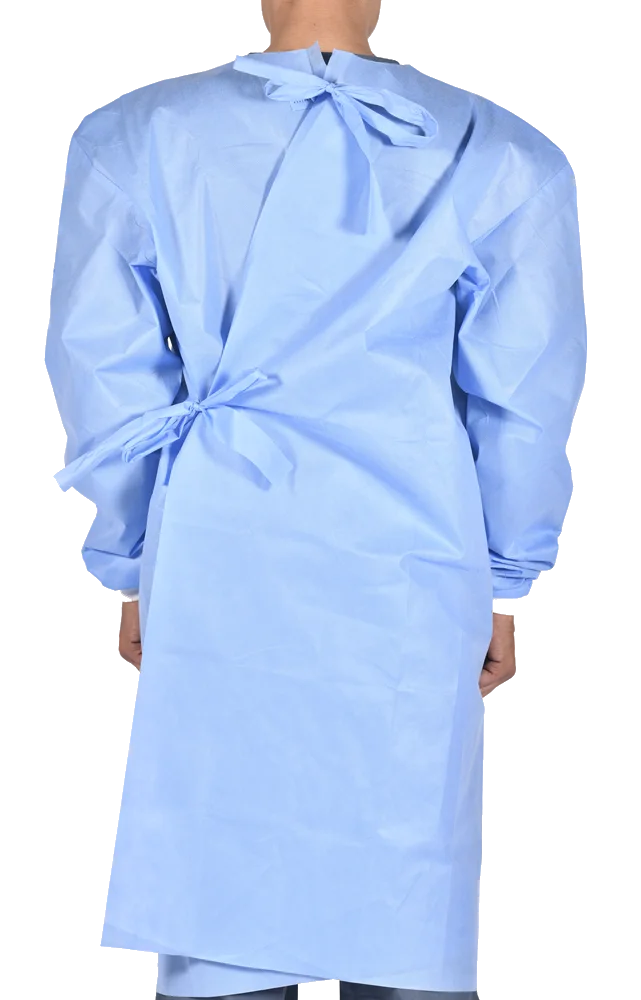
For a surgical gown, the critical zones are the areas most likely to be in direct contact with blood and fluids: the front of the gown from chest to knee, and the sleeves from the cuff to above the elbow. The stated level applies to these zones, including their seams. The back of a surgical gown may be non-protective, which is how manufacturers keep the garment breathable.
This is why a reinforced surgical gown can achieve a higher level than a standard gown made from the same base fabric: an additional impervious or film-laminated layer is added to the chest and forearms, and the sleeve seams are sealed or constructed to resist leakage. Isolation gowns are treated differently under PB70; the whole garment, with limited exceptions such as cuffs and hems, must meet the claimed level because exposure can come from any direction.
PB70 alongside EN 13795 and IS 17334
Buyers often see three standards on one data sheet. EN 13795 is the European standard for surgical gowns, drapes and clean air suits. It takes a wider view than PB70, covering microbial penetration in wet and dry conditions, cleanliness, linting and strength as well as liquid resistance, and it divides products into standard performance and high performance categories. IS 17334:2019 is the Indian Standard for surgical gowns and surgical drapes.
The systems are not directly interchangeable. A PB70 level cannot be converted into an EN 13795 class by a formula, because the test methods and the properties covered differ. If a market or a tender requires a particular standard, the product needs test evidence against that standard. More detail on how these fit together is on our quality and certifications page.
Questions to put to a gown supplier
A level printed on a carton is a claim. Before approving a product, ask for the detail behind it:
- Which components were tested: base fabric, reinforcement, sleeve seam, and any point of attachment in the critical zone?
- Which edition of the standard and which test methods were used, and was the testing done by an independent laboratory?
- Does the report relate to the finished, sterilised product or only to the roll goods?
- Is the level marked on the gown or its packaging so that theatre staff can identify it at the point of use?
- What controls keep production batches consistent with the tested sample?
Shrisay Medical manufactures standard and reinforced surgical gowns in Faridabad, with the reinforced gown described as offering AAMI Level 3–4 protection; to discuss the level and configuration suited to your case mix, please contact our team.
Frequently asked questions
Is a Level 4 gown always the safest choice?
Level 4 gives the highest liquid and viral barrier, but it is usually less breathable and costs more. For short, low-fluid procedures a lower level may be appropriate, as decided by hospital protocol.
Does AAMI PB70 cover sterility or comfort?
No. PB70 classifies liquid barrier performance only. Sterility, breathability, strength and linting are addressed by other standards and should be specified separately.
Can an AAMI level be converted to an EN 13795 class?
Not directly. The two standards use different tests and cover different properties, so a product needs to be tested against whichever standard the buyer or market requires.