Key takeaways
- A wraparound gown has an extra back panel that overlaps the first closure, so no scrub suit is exposed behind the wearer.
- The transfer card lets a non-sterile assistant hold the long outer tie indirectly while the wearer turns into the wrap panel.
- Theatre teaching still treats the back of a worn gown as unsterile, because it cannot be kept in view; the wrap panel is a safety margin, not a working surface.
- Hand towels packed with the gown serve water-based scrubbing and should be checked for absorbency and linting when wet.
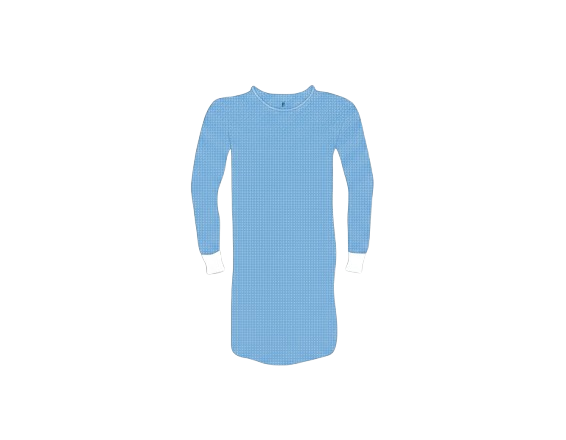
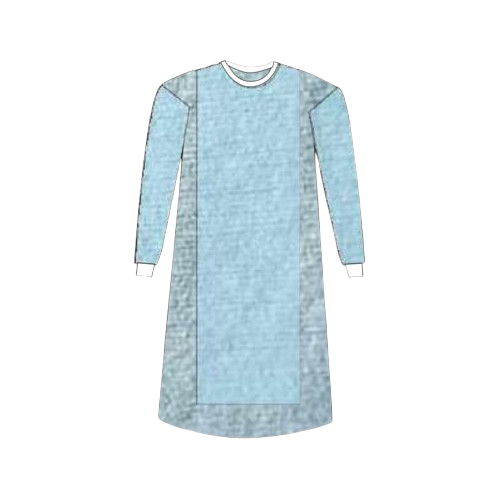
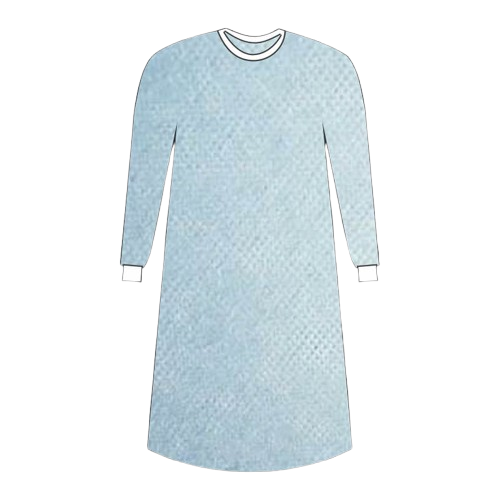
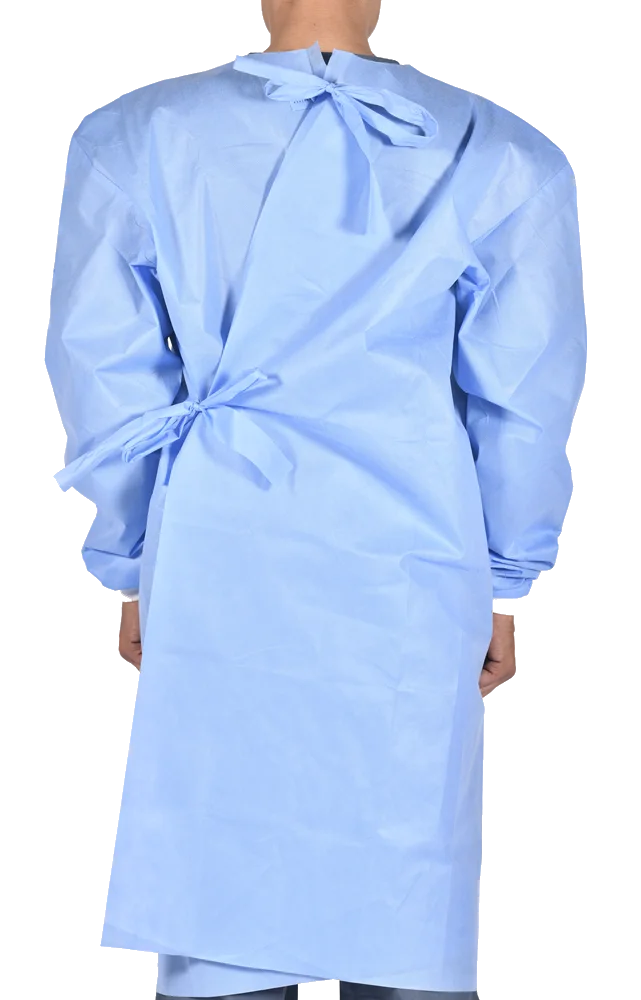
Two surgical gowns can share the same fabric, the same barrier level and the same sleeve construction and still behave very differently once the wearer turns away from the table. The difference lies at the back. An open-back gown fastens behind the neck and waist and leaves a strip of scrub suit exposed. A wraparound gown carries an additional panel that crosses the back and is secured at the side, so the wearer is covered all the way round.
This article describes how the closure is built, how the transfer card is used, and how far the idea of a “sterile back” can reasonably be taken.
How a wraparound gown is constructed
The body of a wraparound gown is cut wider on one side than the other. Once the gown is on, the narrower back edge is closed first, and the wider edge — the wrap panel — is then carried across it, overlapping generously.
Four fastening points are normally involved:
- Neck closure — hook-and-loop tabs or a pair of ties at the back of the neck.
- Inner waist ties — a pair of ties on the inside of the gown that hold the narrower back edge in place.
- Outer tie on the wrap panel — a longer tie attached to the free edge of the wrap panel.
- Outer tie at the front or side — a shorter tie that meets the long one, usually at the wearer’s side or front waist.
The neck and inner ties are fastened by the circulating nurse, who is not scrubbed. The two outer ties are the wearer’s own responsibility, and they are where the transfer card comes in.
The transfer card and the turn
The two outer ties arrive tucked into a folded card, or tab, fixed lightly to the front of the gown. The card has a simple purpose: it gives a non-sterile person something to hold that is not the tie itself. The usual sequence is as follows, though each hospital teaches its own version.
- After gowning and gloving, the wearer takes hold of the card and frees the shorter tie, keeping it in one gloved hand.
- The wearer passes the card, with the long tie still held in it, to the circulating nurse, who grips only the card.
- The wearer turns through roughly three-quarters of a circle, away from the card, so that the wrap panel is drawn across the back.
- The wearer takes the long tie and pulls it out of the card. The nurse keeps the card and does not touch the tie.
- The wearer ties the two outer ties together at the side or front, where the knot stays in view.
If a second scrubbed person is available, they can take the tie directly with a gloved hand and the card is not needed. What matters is that nothing non-sterile touches the tie that will end up at the front of the gown.
What is, and is not, considered sterile
A wraparound gown is sterile all over when it leaves its pack. Even so, theatre teaching does not usually treat the back of a worn gown as part of the sterile field. The reasoning is practical: the wearer cannot see it, cannot guard it, and cannot know whether it has brushed a wall, a door or a colleague.
Conventional teaching limits the sterile area of a worn gown to the front, from the chest down to the level of the sterile field, and to the sleeves from a little above the elbow down to the cuff. The neckline, shoulders, underarms and back are regarded as unsterile once the gown is on, and the knitted cuffs are regarded as unsterile once the hands have passed through them. Local policy defines the exact limits, and our refresher on the principles of the sterile field covers the wider rules.
What the wrap panel offers, then, is not a second sterile surface to work from but a margin of safety. It covers non-sterile scrub attire, keeps loose inner ties out of the way, and reduces the consequences of an accidental contact when two scrubbed people pass in a crowded theatre. The back panel is not normally part of the tested critical zone; the article on the critical zones of a surgical gown explains where the barrier claim applies.
Hand towels in the pack
Many wraparound gowns are folded inside a sterile inner wrap together with one or two absorbent hand towels, placed on top so they are the first thing the scrubbed person picks up. They are there for teams that scrub with antiseptic and water and need to dry their hands and forearms before the gown goes on.
- Drying proceeds from the fingers towards the elbow, without returning to an area already dried.
- A fresh towel, or a fresh part of the same towel, is used for the second arm.
- The used towel is discarded away from the sterile pack.
Where surgical hand preparation is done with an alcohol-based rub, the hands are allowed to dry in air and the towels may go unused; whether they are still wanted in the pack is a question for the theatre team. The same absorbent hand towel is available as a separate item for packs that need extra.
Wraparound and open-back gowns compared
| Point | Wraparound gown | Open-back gown |
|---|---|---|
| Back coverage | Overlapping panel covers the whole back | Back edges meet or leave a gap over the scrub suit |
| Closure | Neck, inner ties and two outer ties secured at the side or front | Neck and waist ties fastened behind by an assistant |
| Help needed | Assistant for neck and inner ties; card or colleague for the turn | Assistant for all ties |
| Typical use | Scrubbed surgical team at the operating table | Short procedures or roles where local policy accepts an open back |
Neither style changes the barrier level of the front and sleeves. That is determined by the fabric, the reinforcement and the seams.
What to check when evaluating a sample
- Overlap. With the gown on the largest intended wearer, the wrap panel should still cross the back fully and stay closed when the wearer bends and reaches.
- Tie length and attachment. The long tie must reach comfortably round the waist, and both ties should withstand a firm pull without tearing away from the gown.
- The card. It should hold the ties securely in the pack, be easy to grip, and release the tie cleanly without shredding.
- Fold. The gown should open with the inside facing the wearer, so that the outside is not handled.
- Towels. Check absorbency and linting with wet hands, not dry ones.
Shrisay Medical manufactures a wraparound sterile surgical gown with hand towels in Faridabad, made to order in size, fabric and pack configuration; for samples or specifications, please contact our team.
Frequently asked questions
Does a wraparound gown have a sterile back?
The whole gown is sterile when packed, but once worn the back is generally regarded as unsterile because the wearer cannot see or protect it. Local policy defines the exact sterile limits.
Who may hold the transfer card?
A non-sterile circulating nurse may hold the card, provided they touch only the card and never the tie. A scrubbed colleague can instead take the tie directly with a gloved hand.
Are the hand towels needed if the team uses alcohol hand rub?
With an alcohol-based surgical rub the hands are normally left to dry in air, so the towels may not be used. Whether to keep them in the pack is decided by the theatre team.