Key takeaways
- A reinforced gown is a standard gown with an added liquid-resistant layer over the chest, abdomen and forearms.
- Reinforcement matters most where there is prolonged wet contact, pressure against the gown or large fluid volumes.
- The extra layer reduces breathability in the covered areas, so it should be placed only where exposure is expected.
- Most theatres are best served by stocking both types and allocating them by procedure and by role at the table.
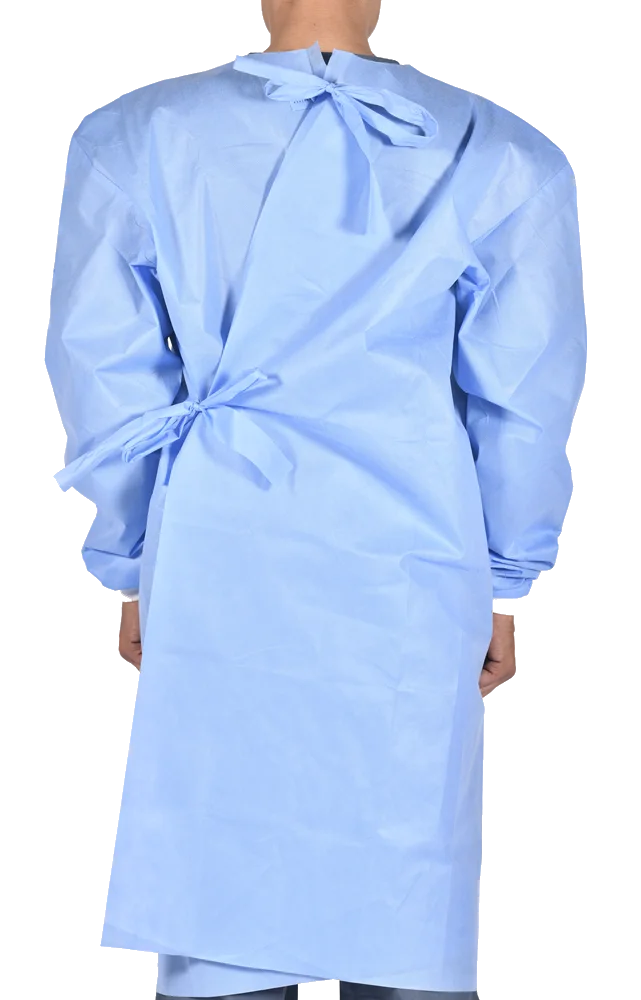
Most single-use surgical gowns start from the same place: a wrap-around garment cut from SMS or a similar multi-layer polypropylene non-woven, with knitted cuffs and a neck closure. The difference between a standard gown and a reinforced one lies in what is added to that base, and where. Understanding that difference helps a hospital avoid two opposite mistakes: putting staff in too little protection for a wet case, or paying for and sweating in heavy protection during a dry one.
How each gown is built
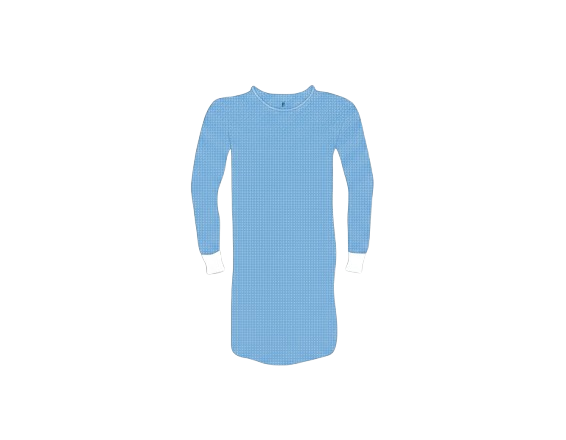
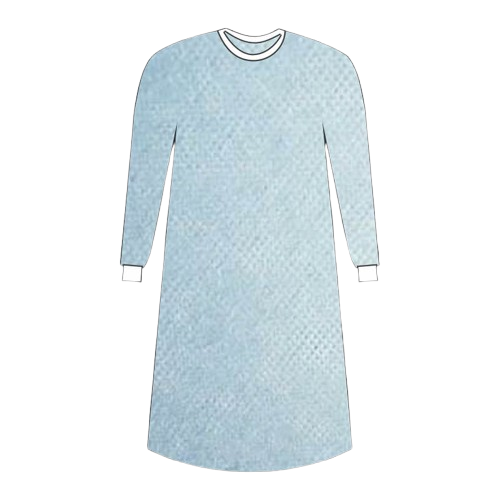
A standard gown, sometimes called a non-reinforced or basic gown, is a single layer of barrier fabric throughout. Its protection comes entirely from the fabric itself, typically SMS or SMMS that has been treated to repel fluids, and from how its seams are made.
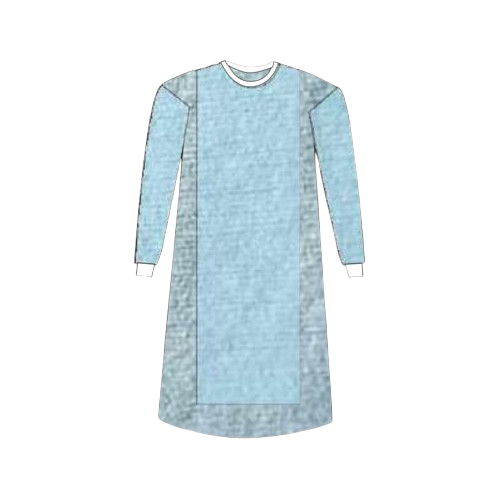
A reinforced gown takes that same body and bonds a second layer inside the zones that face the surgical field. The reinforcement panel usually covers the front from the chest down to around the knee, and the sleeves from the cuff to above the elbow. The panel may be a film-laminated non-woven, a breathable microporous laminate or an impervious poly-coated material, depending on the barrier level being targeted. On higher-specification gowns the sleeve seams are also sealed or taped, because a stitched seam is a line of needle holes through an otherwise sound barrier.
The fluid pathways reinforcement is designed to block
Liquid does not pass through a gown evenly. It passes where three things coincide: fluid is present, the fabric is pressed against something, and the contact lasts. That combination explains the typical failure points.
- Forearms — the sleeves rest on wet drapes, enter body cavities and take the run-off from irrigation. Pressure from leaning on the patient pushes fluid into the fabric.
- Abdomen and lower chest — the surgeon’s body is held against the edge of the table and the drape, often for hours, and pooled fluid at the table edge is squeezed against the gown.
- Sleeve seams — on the underside of the forearm, exactly where contact is heaviest.
A single-layer repellent fabric copes well with splashes and brief contact. Under sustained pressure and soaking, the challenge exceeds what repellency alone can resist, and this is called strike-through. The reinforcement panel exists to raise resistance in precisely those zones.
Side-by-side comparison
| Aspect | Standard gown | Reinforced gown |
|---|---|---|
| Construction | Single layer of barrier non-woven throughout | Base gown plus an added panel on front and forearms |
| Typical barrier positioning | Low to moderate fluid exposure | Moderate to high fluid exposure |
| Sleeve seams | Usually stitched or ultrasonically welded | Often sealed or taped in the critical zone |
| Breathability | Higher across the whole garment | Reduced under the panel; unchanged at the back |
| Weight and drape | Lighter, softer, easier to move in | Heavier and somewhat stiffer at the front |
| Unit cost | Lower | Higher, reflecting extra material and process steps |
| Typical use | Short or minimally invasive procedures; circulating and assisting roles | Long, open or fluid-intensive procedures; operating surgeon and first assistant |
The barrier positions in the table are general. The actual classification of any gown under AAMI PB70, EN 13795 or IS 17334 depends on test results for that specific product, and should be confirmed from the supplier’s documentation.
Procedures where the extra layer earns its place
The choice is made by the hospital’s protocol and the surgical team, but the reasoning usually follows the fluid. Reinforced gowns are commonly preferred for:
- Orthopaedic surgery, particularly joint replacement and trauma, where irrigation is heavy and the surgeon works with force against the limb.
- Caesarean section and other obstetric procedures with large volumes of blood and amniotic fluid.
- Open abdominal, cardiac and vascular surgery, where the forearms are in the cavity for long periods.
- Urological and arthroscopic procedures that use continuous irrigation.
- Any case in which the patient has a known or suspected blood-borne infection.
Standard gowns generally serve well for short procedures with little bleeding, such as many ophthalmic, ENT, minor plastic and day-care cases, and for team members who stand back from the field. Using a reinforced gown for every person in every case is not wrong, but it adds cost and heat load without a matching benefit.
The comfort cost, and how good design limits it
Every barrier layer slows the escape of body heat and moisture vapour. A surgeon in a reinforced gown under theatre lights for a long procedure will feel that. Thermal discomfort is not a trivial matter; it affects concentration and leads to staff adjusting or loosening their gowns.
Good reinforced gowns manage this in three ways. The panel is confined to the critical zones rather than extended across the whole front and sleeve. The back and the upper sleeve remain single-layer and breathable, so heat has a route out. And where the specification allows, the reinforcement itself is a breathable laminate rather than a solid film. When you evaluate samples, have theatre staff wear them through a real working session rather than judging the fabric by hand.
Building a sensible gown mix
For most hospitals the practical answer is not one gown but two or three, allocated by procedure type and role. A simple approach:
- List your procedures by speciality and group them by expected fluid exposure: low, moderate or high.
- Assign a gown type to each group, and note which roles at the table need the higher protection.
- Reflect that allocation in your procedure packs, so the right gown arrives with the right case. Our kits and packs can be configured this way.
- Review after a few months using feedback from theatre staff on strike-through and comfort.
Points to confirm before ordering
When requesting samples or quotations, ask the supplier for the exact area covered by the reinforcement, the material of the panel, how the sleeve seams are made, the barrier standard and level the finished gown has been tested to, and the available sizes. Check that standard and reinforced gowns are easy to tell apart on the pack label and on the gown itself, because mix-ups in a busy store are common.
Shrisay Medical manufactures both standard and reinforced gowns at its Faridabad facility, with the reinforced gown described as offering AAMI Level 3–4 protection and sizes customisable to requirement; the full range is on our surgical gowns page.
Frequently asked questions
Is a reinforced gown the same as an AAMI Level 4 gown?
Not necessarily. Reinforcement raises barrier performance in the critical zones, but the level achieved depends on the materials, the seams and the test results for that specific gown.
Does the reinforcement cover the whole gown?
No. It typically covers the front from chest to around the knee and the forearms, which are the areas most exposed to fluid. The back is left single-layer for breathability.
Should every member of the surgical team wear a reinforced gown?
That is a matter for hospital protocol. Many theatres give reinforced gowns to the operating surgeon and first assistant in wet cases and standard gowns to those further from the field.