Key takeaways
- The critical zones of a surgical gown are the front from chest to knee and the sleeves from cuff to above the elbow.
- A gown’s barrier classification is set by the weakest component within those zones, which is often a seam rather than the fabric.
- The back and upper sleeves are less critical and are deliberately kept lighter so the gown can release heat.
- Even inside the critical zones, the area treated as sterile in practice is narrower than the area that is protective.
Hold a surgical gown up to the light and it looks like one uniform garment. In engineering terms it is a set of zones, each with a different job. Some zones face the wound and take the fluid; others exist mainly to hold the gown on the body and let heat out. Standards recognise this by separating critical from less critical areas and setting different expectations for each. For anyone specifying, buying or inspecting gowns, this zoning is the key to reading a data sheet correctly.
Why a gown is zoned at all
If barrier were the only goal, a gown could be made entirely from impervious film. Nobody could work in it for long. Heat and moisture vapour from the body need to escape, and the fabric needs to be light and flexible enough for precise movement. Zoning resolves the conflict: maximum barrier where exposure is real, maximum comfort where it is not.
AAMI PB70 defines the critical zone of a surgical gown as the areas where direct contact with blood, body fluids and other potentially infectious material is most likely. EN 13795 uses similar reasoning, distinguishing critical product areas from less critical ones and setting more demanding performance requirements for the former. The exact boundaries are defined in the standards themselves and by the manufacturer’s design, so the current text should be consulted for specification work.
The front panel
The front of the gown, from the chest down to around the knee, faces the operative field throughout the procedure. It is exposed in three ways: direct splash and spray, run-off from the drapes, and pressure contact where the wearer leans against the table edge. The last is the most demanding, because pooled fluid squeezed between the drape and the gown is pushed into the fabric over a long period.
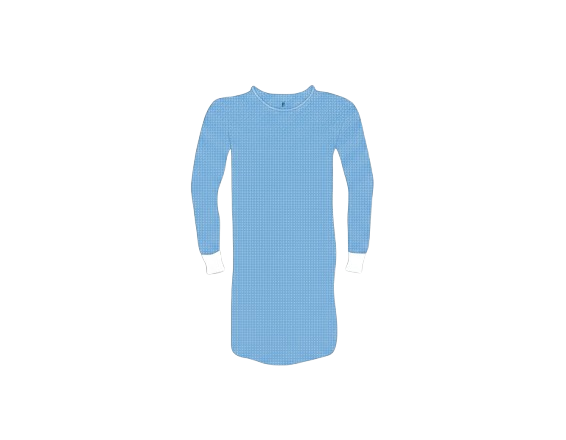
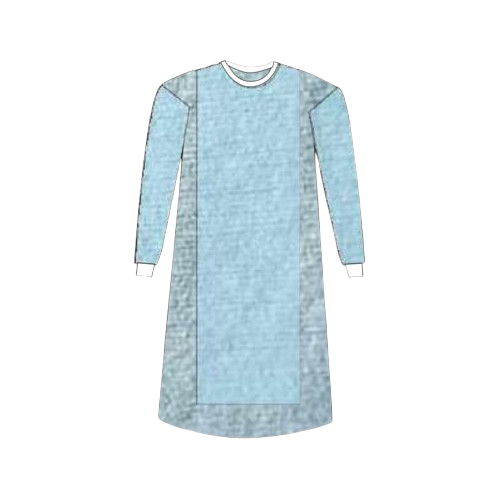
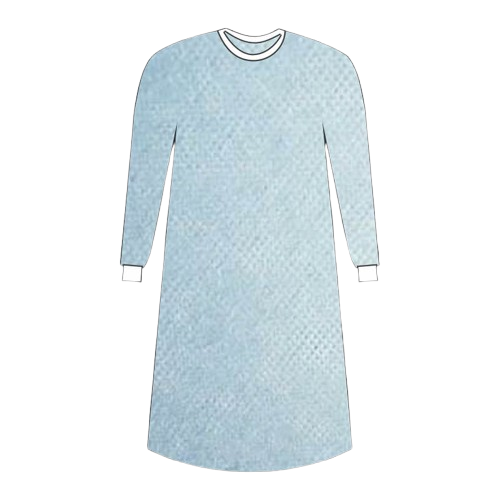
On a standard gown the front is a single layer of repellent non-woven. On a reinforced gown it carries an additional panel, which should be wide enough to cover the abdomen fully and long enough to reach the level where the table edge meets the body. When checking a sample, measure where the panel starts and ends against a person of typical height in your team, not against a drawing.
The sleeves, from cuff to above the elbow
The forearms do more wet work than any other part of the gown. They rest on saturated drapes, enter cavities and sit directly under irrigation. The critical zone of the sleeve runs from the cuff to above the elbow.
Three details deserve attention here:
- The cuff itself. Knitted cuffs are absorbent, not barrier materials. They are intended to be completely covered by the surgical glove, and standards generally exclude them from the barrier requirement.
- The cuff-to-sleeve junction. This is where the barrier fabric meets the knit. The glove should overlap well beyond it, and the join should be neat and free of gaps.
- Reinforcement length. On reinforced gowns the sleeve panel should extend above the elbow, since fluid tracks along the forearm when the arms are raised or lowered.
Seams: the hidden weak point
A seam is where two pieces of barrier fabric are joined, and how they are joined matters as much as the fabric. Under PB70, a gown is classified by the lowest-performing component in the critical zone, and seams are components. This is the single most overlooked point in gown procurement.
| Seam type | How it is made | Barrier implication |
|---|---|---|
| Sewn | Needle and thread through both layers | Needle holes create potential leak paths; generally suited to lower barrier requirements or non-critical areas |
| Ultrasonically welded | Layers fused by vibration and pressure, without thread | No needle holes; quality depends on a consistent, continuous bond |
| Heat sealed or taped | Seam covered or bonded with a sealing tape or film | Used where the highest liquid resistance is required at the join |
The sleeve seam is the important one. It usually runs along the underside of the forearm, which is precisely where the arm rests on wet surfaces. Some designs move it or use a raglan sleeve so that the shoulder seam sits outside the critical zone and allows freer movement. When inspecting a sample, turn the sleeve inside out, look along the full length of the seam for skipped welds or puckering, and pull gently across it to check the bond.
The back and other less critical areas
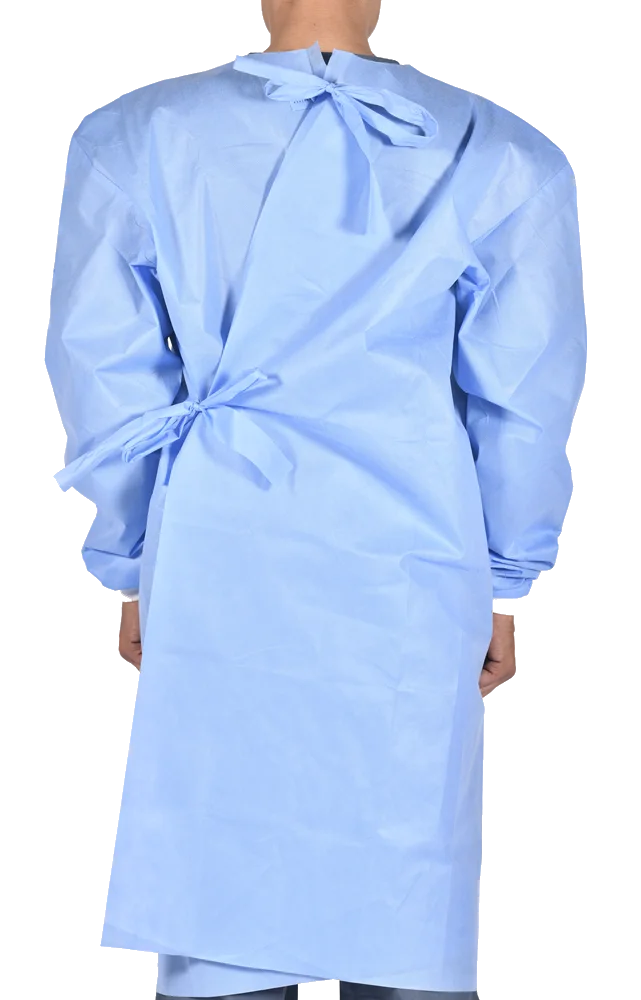
The back of a surgical gown does not face the field and is not expected to meet fluid. Under PB70 it may be non-protective. It does, however, need to provide full coverage: a properly sized wrap-around back panel should overlap and close completely, so that the wearer’s scrub suit is covered when the gown is tied.
Other less critical areas include the upper sleeves, the shoulders and the lower hem. These still have requirements under standards such as EN 13795, including strength and cleanliness, but the barrier demand is lower. Keeping these areas single-layer and breathable is a design choice, not a shortcut.
Protective zone and sterile zone are not the same thing
Theatre practice adds a further distinction. Once a gown is on, most hospital protocols treat only part of it as sterile: broadly, the front from chest to the level of the sterile field, and the sleeves from above the elbow to the cuff. The back, the shoulders, the area under the arms and anything below table level are regarded as unsterile, because they cannot be kept in view. These working rules come from perioperative guidelines and local protocol, not from product standards, and they should be followed as taught in your facility.
The practical point for buyers is that barrier zoning and sterile-field practice reinforce each other. Both concentrate attention on the same front-and-forearm region, which is why gown design and drape design are best considered together.
A short inspection routine for sample gowns
- Unfold the gown and identify where any reinforcement begins and ends on the front and sleeves.
- Examine sleeve seams inside and out along their full length.
- Check the cuff attachment and confirm the cuff sits comfortably under your usual surgical gloves.
- Put the gown on a team member and confirm the back panel overlaps and closes fully.
- Ask the supplier which components the barrier test report covers.
Shrisay Medical manufactures standard and reinforced surgical gowns in Faridabad and can adjust reinforcement coverage and sizing to requirement; samples and specifications are available through our contact page.
Frequently asked questions
Which parts of a surgical gown are the critical zones?
The front of the gown from chest to knee and the sleeves from the cuff to above the elbow. These are the areas most likely to contact blood and body fluids.
Are the knitted cuffs part of the barrier?
No. Knitted cuffs are absorbent and are meant to be fully covered by the surgical glove, so they are generally excluded from the barrier requirement.
Why do sleeve seams matter so much?
A gown is classified by its weakest critical zone component, and the sleeve seam lies where the forearm rests on wet surfaces. A poorly made seam can leak even when the fabric does not.