Key takeaways
- Knitted cuffs are comfortable and sit well under gloves, but they are absorbent and must be fully covered by the glove.
- Hook-and-loop neck closures are quick and adjustable, while ties lie flatter; both should be checked for scratching, snagging and ease of release.
- Tie attachment strength matters because a tie that tears away can leave a hole in the front of the gown.
- Raglan sleeves give more freedom of movement than set-in sleeves, and a wear trial is the best way to judge any of these details.
Gown specifications are written around fabric and barrier performance, and rightly so. The feedback that comes back from theatre after a change of supplier is usually about something else: a cuff that rides out of the glove, a neck tab that catches on a cap, a tie that tears off in the hand, a sleeve that pulls when the surgeon reaches across the table.
Cuffs: knitted or elastic
The cuff has one job in a surgical gown: to hold the end of the sleeve snugly at the wrist so that a glove can be drawn over it and stay there. Two constructions are common.
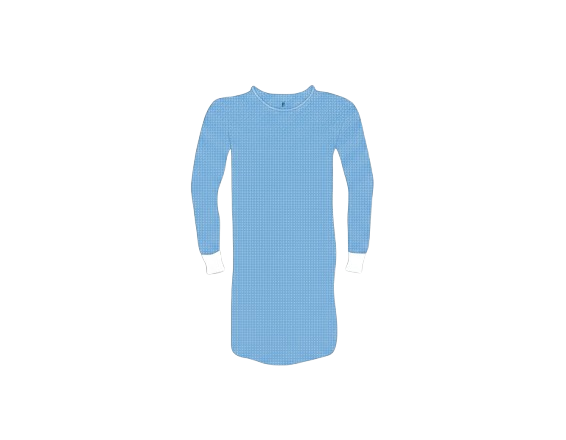
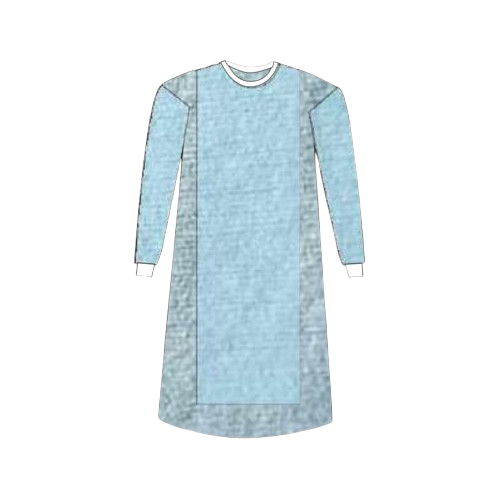
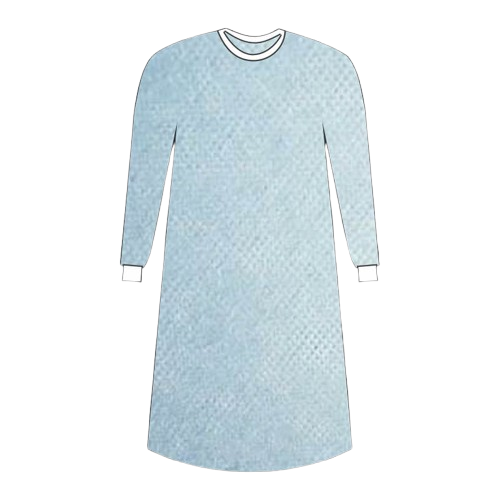
- Knitted (rib) cuffs are tubes of stretch knit, usually polyester or a cotton blend, sewn to the end of the sleeve. They grip gently over a range of wrist sizes, sit flat under a glove and are comfortable over a long case. They are the usual choice for sterile surgical gowns.
- Elastic cuffs are made by gathering the sleeve fabric itself over an elastic. They cost less and keep the gown fabric continuous to the wrist, but they are bulkier under a glove and can feel tight. They are more often found on isolation, visitor and patient gowns.
Two points about knitted cuffs are worth stating plainly. First, a knit is absorbent and is not a liquid barrier; barrier standards generally leave the cuff outside the critical zone for that reason. The cuff therefore has to be covered completely by the glove, and the junction between sleeve and cuff should sit well inside the glove’s length. Second, the cuff is joined to the sleeve by a seam, and a bulky or scratchy seam at the wrist is felt for the whole procedure.
Neck closures
The neck is fastened by an unscrubbed assistant standing behind the wearer, often in a hurry. The closure needs to be quick, adjustable and secure, and it should not irritate the skin of the neck.
- Hook-and-loop tabs are fast and adjust to different neck sizes. The hook side can scratch if it is positioned badly or left partly exposed, it can snag bouffant caps and hair, and a short tab limits the range of adjustment. It is worth checking that the hook material does not pull fibres from the gown itself, since loose fibre is unwelcome in theatre; our article on lint and particles in the theatre explains why.
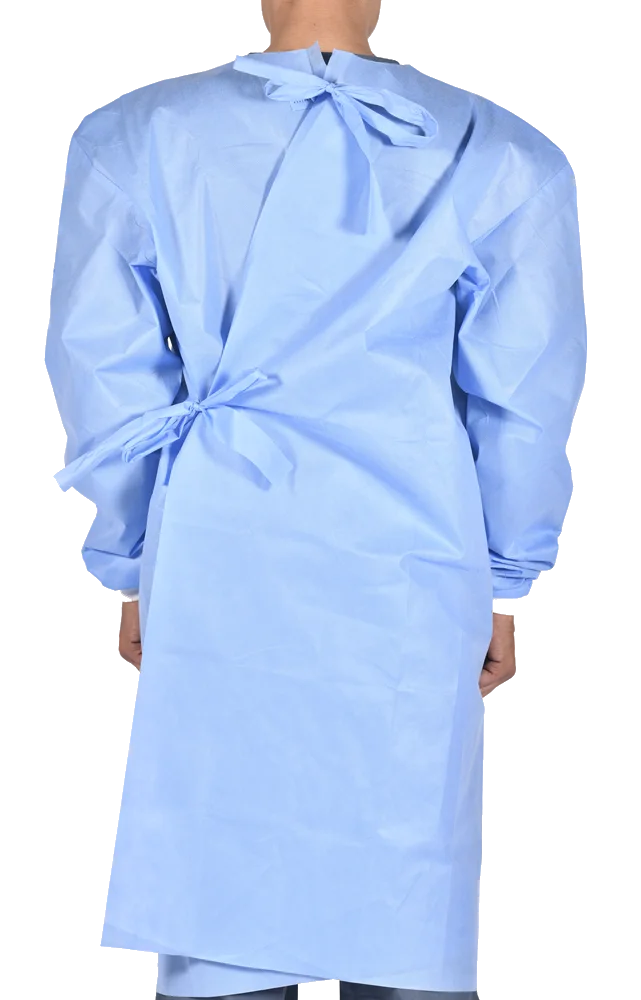
- Neck ties are simple, lie flat and adjust to any size. They take a few seconds longer to fasten, and a knot pulled tight can be awkward to undo with gloved hands at the end of a case.
- Adhesive tabs appear on some lighter gowns. They are quick but generally allow only one or two repositionings.
The neckline itself matters too. A neckline cut too low exposes scrub suit at the chest; one cut too high presses on the throat when the wearer looks down. A soft binding around the neck edge is kinder to skin than a raw-cut edge of stiff fabric.
Ties: inner, outer and how they are attached
A wraparound gown has inner ties that hold the first back edge in place and outer ties that secure the wrap panel at the side or front. An open-back gown has waist ties at the back only. In either case three things need checking.
- Length. The ties must reach comfortably on the largest wearer of each size, with enough left to form a bow.
- Attachment strength. Ties are attached by stitching, by ultrasonic welding or by both. A tie that pulls away takes a piece of the gown with it, and if that happens at the front it leaves a hole in a place that matters. A firm, steady pull on each tie of several sample gowns is a simple and revealing test.
- Position. An outer tie attached within the front of the gown is a point of attachment inside the area where barrier performance is claimed. The critical zones of a surgical gown include such attachment points, so it is reasonable to ask how the supplier has addressed them.
Sleeves: raglan and set-in
The sleeve can be joined to the body in two ways. A set-in sleeve is attached around the armhole, with a seam that circles the shoulder, as in a shirt. A raglan sleeve extends in one piece up to the neckline, so the seams run diagonally from the underarm to the neck and there is no seam across the top of the shoulder.
Raglan sleeves are widely preferred for surgical gowns because they give more freedom when reaching forward or raising the arms, and because they fit a wider range of shoulder widths within a single size. A set-in sleeve uses fabric economically and looks neat, but can bind across the upper back if the gown is on the small side for the wearer.
Whichever is used, the long seam that closes the sleeve from underarm to cuff lies within the area of greatest exposure. How that seam is made, whether sewn, welded or sealed, has a direct bearing on the barrier claim, and its position should keep it away from the inner forearm where possible. Sleeve length matters just as much, and our guide to surgical gown sizing and fit deals with measurements.
A checklist for sample evaluation
| Detail | Common options | What to check on a sample |
|---|---|---|
| Cuff | Knitted rib; elasticated | Recovery after stretching, linting, comfort of the joining seam, glove stays over the cuff |
| Neck closure | Hook-and-loop; ties; adhesive tab | Range of adjustment, scratching, snagging on caps, ease of release |
| Neckline | Bound edge; raw edge | Coverage of scrub suit, pressure on the throat when looking down |
| Ties | Stitched; welded; both | Length on the largest wearer, resistance to a firm pull, release from the card |
| Sleeve | Raglan; set-in | Reach forward and overhead without binding or cuff pull-out |
| Sleeve seam | Sewn; welded; sealed | Position, flatness against the skin, evidence supporting the barrier claim |
Turning preferences into a specification
The most useful evaluation is a wear trial: several people of different builds, wearing the gown with their usual gloves through real or simulated movement, and reporting against a short list such as the one above. Laboratory reports cannot tell a buyer whether the neck tab scratches.
Once a preference is established, write it down. A requirement for “knitted cuffs, hook-and-loop neck closure, raglan sleeves and four ties” is easy to state and easy to verify on delivery. It also prevents a quiet substitution later, when a like-for-like replacement turns out to differ in exactly the detail that staff had come to rely on.
Shrisay Medical manufactures surgical gowns in Faridabad to order, including the standard surgical gown, with size, fabric and pack configuration agreed with the buyer; to request samples for a wear trial, please contact our team.
Frequently asked questions
Are knitted cuffs part of the barrier of a surgical gown?
No. Knitted cuffs are absorbent and are generally excluded from the critical zone in barrier standards. They rely on being completely covered by the glove.
Is a hook-and-loop neck closure better than ties?
Neither is better in every case. Hook-and-loop is faster and adjustable but can scratch or snag, while ties are flat and simple but slower to fasten and undo. Staff preference from a wear trial should decide.
Why do many surgical gowns use raglan sleeves?
A raglan sleeve has no seam across the shoulder and allows freer movement when reaching forward or upward. It also fits a wider range of shoulder widths within one size.