Key takeaways
- A coverall gives all-round coverage including the back and legs, while a gown protects the front and arms and is open or tied at the back.
- Coverage and barrier are separate: the fabric and seams, tested to a named standard, determine how well either garment resists fluid.
- Coveralls cause more heat stress and are harder to remove without self-contamination, so they demand training and a fixed doffing sequence.
- Gowns suit most direct patient care, while coveralls suit cleaning, waste handling and settings where exposure can come from any direction.
During large outbreaks the hooded white coverall became the public image of protective clothing, and many hospitals built up stocks of them. Once the pressure eased, a practical question remained: for everyday work, which tasks call for a coverall, and which are better done in a gown or an apron?
The answer depends on where the contamination comes from, how long the garment is worn, and how safely it can be taken off. Coverage is only one of those three.
Two different shapes of protection
A coverall is a one-piece garment covering the trunk, arms and legs, closed at the front with a zip that is usually covered by a storm flap. Most have elastic at the wrists, ankles and waist, and many have an attached hood; some include integral boot covers. Protection extends all round the body, including the back and lower legs.
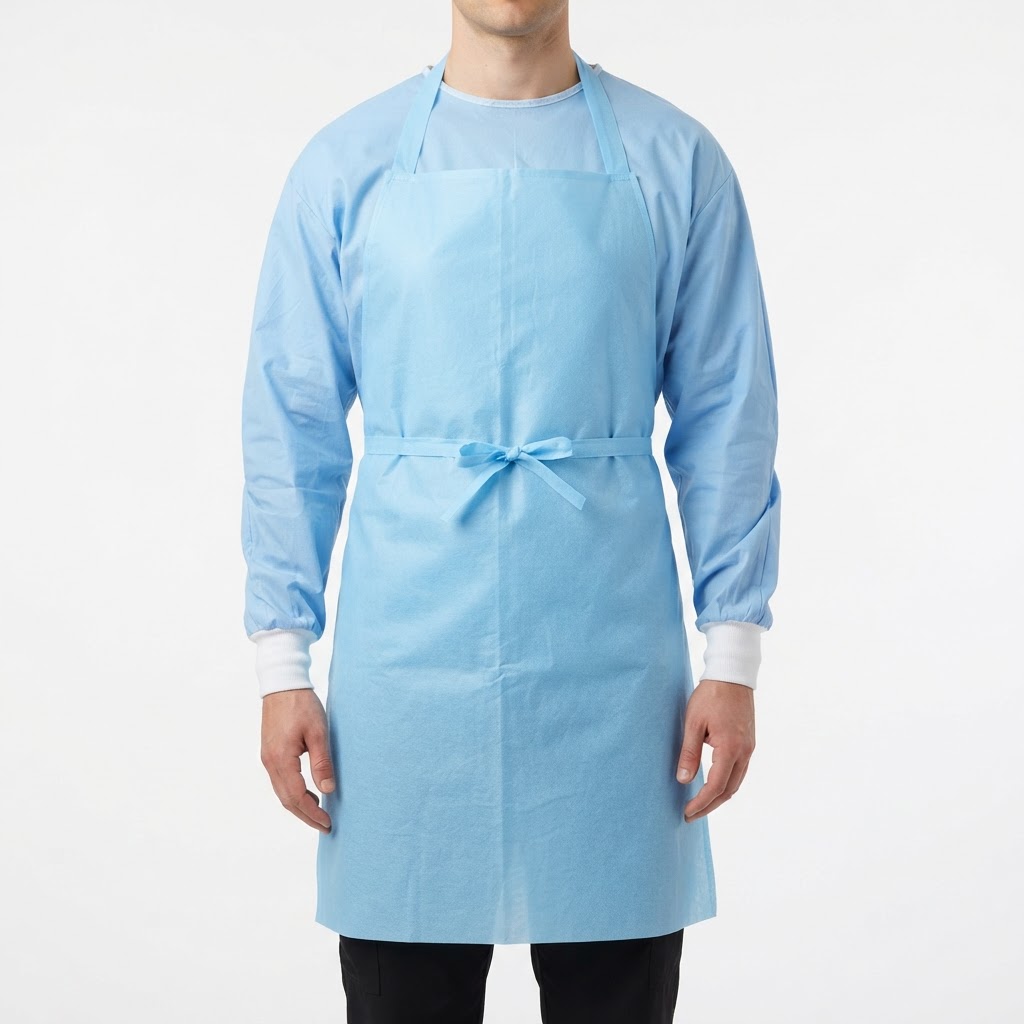
A gown covers the front of the body and the arms, from the neck to the knee or mid-calf, and fastens at the back. An isolation gown is expected to protect over its whole area, but the rear closure, the lower legs and the head and neck are not enclosed. Those areas are covered, when necessary, by separate items.
The two therefore answer different exposure patterns. A gown suits contamination that arrives from the front, at about bed or table height, which describes most direct patient care. A coverall suits contamination that may come from any direction, or from below: splashing at floor level, aerosolised dust, kneeling or crawling, or moving through a heavily contaminated space.
Coverage is not the same as barrier
A garment’s shape says nothing about how well its fabric and seams resist liquids or micro-organisms. A thin spunbond coverall with stitched seams covers the whole body and will still let fluid through under modest pressure, while a well-made gown in a higher-barrier fabric can outperform it wherever the two overlap.
Both garment types are made in a range of materials, from plain polypropylene to SMS, microporous film laminates and impervious coated fabrics, and with seams that are stitched, bound, welded or taped. Gowns are usually described using the frameworks compared in our article on IS 17334, EN 13795 and AAMI PB70. Coveralls are usually described under protective-clothing standards, which classify whole garments by the type of exposure they resist, such as liquid jets, sprays, airborne particles or light splashes, and which have separate tests for resistance to infective agents. A buyer should ask which standard and which class a coverall has been tested to, and check the current edition, instead of inferring protection from appearance.
Heat and fatigue
Enclosing the body has a physiological cost. A coverall traps heat and moisture over a much larger area than a gown, and the open back of a gown is a real source of ventilation. In warm, humid conditions, which describes many Indian wards and service areas for much of the year, a worker in a coverall with a hood, mask and eye protection heats up quickly.
The consequences are practical ones: shorter safe working periods, more frequent breaks, dehydration, fogged eyewear, loss of concentration, and a temptation to unzip or adjust the garment in a contaminated area. More impervious fabrics make this worse. The trade-off between barrier and comfort is discussed in our article on breathability versus barrier in gown fabrics, and it applies with greater force to a garment that covers everything.
Taking it off: the doffing risk
Protective clothing has to be removed while its outside is contaminated, and this is where the two garments differ most.
- A gown is untied at the back, pulled forward from the shoulders and rolled away from the body, inside out. It never passes over the head or the feet, and removal takes a few seconds.
- A coverall has to be unzipped at the front, where contamination is likely to be greatest, and the hood has to be pushed back from the head. The garment is then rolled down over the shoulders, arms, hips and legs, and finally worked over the shoes or boots, often while balancing on one leg.
Each of those steps is an opportunity for the outside of the garment to touch skin, hair or inner clothing. For that reason coverall removal is normally taught as a fixed sequence, practised beforehand, and in high-risk settings carried out slowly with a trained observer. A garment that covers more and is then removed badly can leave the wearer worse off than a gown removed well. Related precautions are outlined in our article on draping and gowning for high-risk cases.
Matching the garment to the task
| Task or setting | Usual choice | Reasoning |
|---|---|---|
| Routine patient care under contact precautions | Isolation gown | Exposure is frontal; frequent changes between patients; easy removal |
| Surgery and invasive procedures | Sterile surgical gown | Sterile front and sleeves are required; a coverall is not designed for the sterile field |
| Terminal cleaning and decontamination of heavily soiled areas | Coverall, or gown with apron, as policy directs | Splashing at low level, kneeling and contact from all sides |
| Handling and transport of biomedical waste | Coverall or heavy-duty apron with other protection | Contact with bags and bins against the body and legs |
| Certain outbreak and high-consequence infection settings | Coverall or gown, as directed by the outbreak protocol | Whole-body coverage may be specified; either may be acceptable with the right accessories |
| Brief, low-risk tasks with splash to the front only | Plastic or non-woven apron | Minimal exposure; quickest to change |
These are general conventions. The hospital’s infection-control policy, and in an outbreak the instructions of the health authorities, decide what is worn. Waste handlers’ protective equipment is also addressed in the Bio-Medical Waste Management Rules 2016, which the facility must follow.
Fit, accessories and supply
A coverall has to fit in more dimensions than a gown. Too small, and it tears at the crotch or underarm when the wearer bends or reaches; too large, and loose fabric drags on the floor and snags. A range of sizes is necessary, and staff should know their own size before they need it urgently.
Neither garment is complete alone. Gloves must overlap the cuffs, and depending on the task the wearer may need a mask or respirator, eye protection, a cap or hood, and boots or shoe covers. When comparing options, compare complete ensembles:
- the number of separate items and the time taken to put them on and take them off;
- how the junctions at wrist, neck and ankle are closed;
- storage volume and cost per use, including the accessories;
- the training needed for safe removal.
Shrisay Medical manufactures gowns and the disposable coverall in Faridabad, made to order in size and fabric; to discuss which garments suit your tasks, please contact our team.
Frequently asked questions
Is a coverall always more protective than a gown?
No. A coverall covers more of the body, but protection also depends on the fabric, the seams and how safely the garment is removed. A gown in a higher-barrier fabric can be the better choice for frontal exposure.
Can a coverall be worn for surgery in place of a sterile gown?
A coverall is not designed for the sterile field and does not replace a sterile surgical gown for the scrubbed team. Theatre attire is determined by hospital policy.
Why is taking off a coverall considered risky?
The zip is at the contaminated front, the hood passes over the head, and the garment must be worked down over the legs and shoes. Each step can bring the outer surface into contact with skin or inner clothing.