Key takeaways
- Barrier means resisting liquid under pressure; breathability means letting moisture vapour and heat escape, and the two tend to trade off.
- Porous fabrics such as SMS breathe well but have a limit to the liquid pressure they resist, while film laminates resist more and breathe less.
- Microporous and monolithic films allow water vapour through while blocking liquid, narrowing the trade-off at higher cost.
- Zoned gown design places heavy barrier only where exposure occurs and leaves the back and upper sleeves breathable.
Ask a surgeon what they want from a gown and the answer is usually two things: it must not let anything through, and it must not be hot. These requests work against each other. A material that stops liquid tends to stop air and vapour too. Much of the development work in single-use gown fabrics over the years has gone into loosening that link, and the result is a range of materials and designs that sit at different points between a light, airy cover and a fully impervious shield.
Two properties, defined
Barrier in a surgical gown is the fabric’s resistance to penetration by liquids and the micro-organisms they carry. It is measured by tests that apply water or a blood substitute to the fabric, by impact or under rising pressure, and record whether and when it passes through. At the highest levels the challenge includes a virus surrogate.
Breathability is a looser term. It covers two distinct things. Air permeability is how readily air flows through the fabric. Moisture vapour transmission is how readily water vapour, meaning evaporated sweat, passes through. For thermal comfort the second matters more: the body cools itself by evaporating sweat, and if that vapour cannot leave the microclimate between skin and gown, humidity rises and the wearer feels hot and damp.
Barrier standards such as AAMI PB70 classify the first property and say nothing about the second. A gown’s comfort therefore has to be assessed separately, through laboratory data where available and, more usefully, through wear trials.
Why the two pull apart
A non-woven fabric is a web of fibres with spaces between them. Those spaces are how air and vapour get through. They are also how liquid gets through, once the pressure is high enough to overcome the fabric’s repellency. Making the pores smaller, by adding fine meltblown fibres, or adding more material raises liquid resistance and reduces air flow at the same time.
Liquid water and water vapour differ greatly in scale, however. A droplet is enormous compared with a single vapour molecule. Materials that exploit this difference can block the first while allowing the second, which is the principle behind breathable barrier films.
How the main fabric types behave
| Fabric type | How it protects | Liquid barrier | Breathability |
|---|---|---|---|
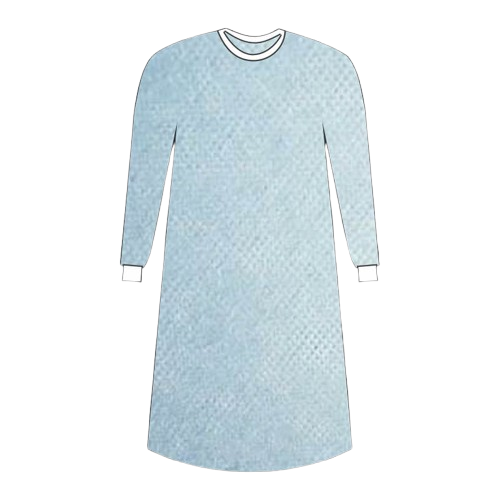
| SMS / SMMS polypropylene | Fine meltblown layer and repellent treatment resist wetting | Low to moderate, depending on weight and construction | Good; porous to air and vapour |
| Spunlace (wood pulp and polyester) with repellent finish | Dense entangled fibres with a fluid-repellent treatment | Low to moderate | Good; soft, textile-like feel |
| Microporous film laminate | Film with pores large enough for vapour but too small for liquid droplets, bonded to non-woven | High | Moderate; vapour passes, air largely does not |
| Monolithic film laminate | Solid film that moves vapour through the polymer itself, with no pores | High, including against viral penetration when so tested | Moderate; depends on film chemistry and thickness |
| Polyethylene-coated or non-breathable film | Continuous impervious layer | High | Poor; neither air nor vapour passes readily |
The ratings are general descriptions. Actual performance depends on the specific material, its weight and its finishing, and must be confirmed from test data for the product in question. The typical constructions we supply are described on our surgical gowns page.
Zoned design: putting barrier only where it is needed
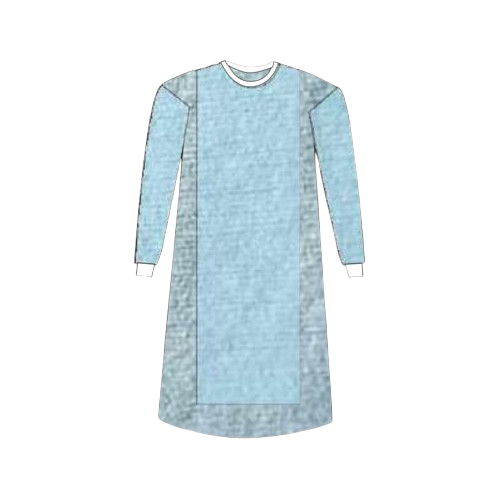
Material science is one half of the answer. Garment design is the other, and it is often the more economical. Since fluid exposure in surgery is concentrated on the front of the body and the forearms, there is no need to apply the heaviest barrier everywhere.
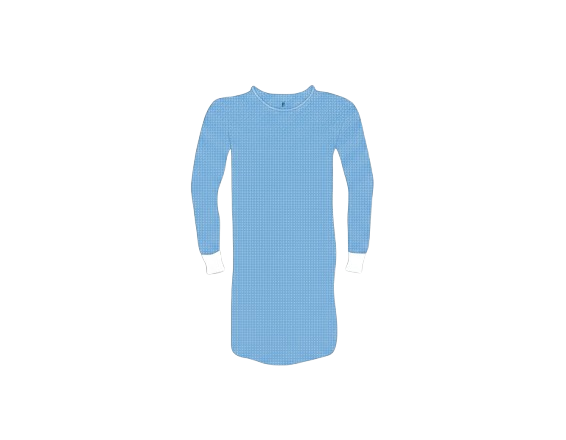
A well-designed reinforced gown uses a breathable base fabric for the whole garment and adds a high-barrier panel only on the chest, abdomen and lower sleeves. The back, shoulders and upper arms, which make up a large share of the gown’s surface, stay light. Because warm air rises and the back is not pressed against anything, this area works as the main route for heat to leave.
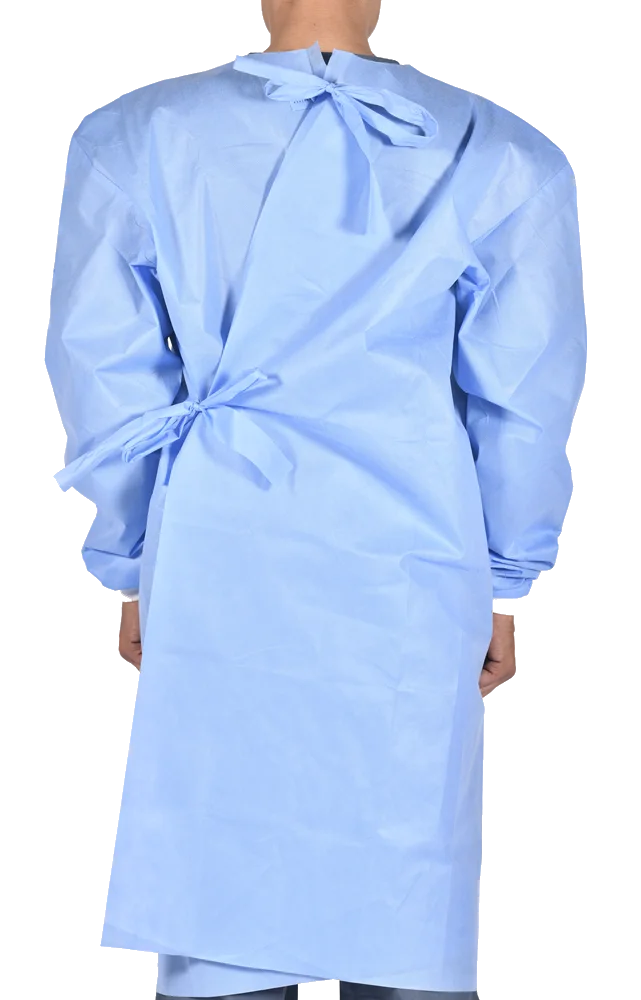
Details help as well. A raglan sleeve gives freedom of movement without stretching the fabric tight against the skin. A back that closes with a generous overlap, rather than a tight wrap, leaves some air movement. An appropriately sized gown matters more than is often recognised: a gown that is too tight presses fabric against the body and removes the air layer that carries vapour away.
What else affects how hot a gown feels
Fabric is only one contributor to thermal load in theatre. Others include:
- Procedure length and physical effort. Orthopaedic work generates far more body heat than microsurgery.
- Theatre temperature and humidity. Warmer rooms, sometimes kept so for the patient’s benefit, reduce the wearer’s ability to lose heat.
- Layers under and over the gown. Scrub suits, lead aprons for imaging-guided work and additional sleeves or aprons all add insulation.
- Operating lights. Radiant heat from above falls on the head and shoulders.
A gown that feels acceptable in a short general surgery list may be oppressive in a long joint replacement under a lead apron. Comfort should therefore be judged in the setting where the gown will be used.
Evaluating comfort before you buy
Barrier claims can be checked on paper. Comfort largely cannot. A structured wear trial is the most reliable method:
- Select two or three candidate gowns that meet the barrier level your protocol requires.
- Have the same staff wear each in comparable procedures of realistic length.
- Collect brief feedback straight afterwards on heat, dampness, freedom of movement and any strike-through.
- Include surgeons who use lead aprons or who work in warmer theatres, as they represent the hardest case.
Ask suppliers whether they hold moisture vapour transmission or air permeability data for their fabrics, and which test method was used, since results from different methods are not comparable. Treat such figures as a guide rather than a verdict.
A balanced specification
The practical aim is not the highest barrier or the best breathability, but the right pairing for each group of procedures. Specify the barrier level by procedure risk, limit reinforcement to the critical zones, choose the correct size, and let staff feedback decide between products that are otherwise equal.
Shrisay Medical manufactures standard and reinforced gowns in Faridabad, with fabric weight and reinforcement customisable to requirement; you can discuss options or request samples through our contact page.
Frequently asked questions
Does a higher barrier level always mean a hotter gown?
Usually the barrier zones are less breathable at higher levels, but breathable film laminates and zoned design reduce the effect. Comfort varies considerably between gowns of the same level.
What is the difference between air permeability and moisture vapour transmission?
Air permeability measures air flow through the fabric, while moisture vapour transmission measures how well evaporated sweat escapes. Some barrier films pass vapour while blocking air and liquid.
Is breathability covered by AAMI PB70?
No. AAMI PB70 classifies liquid barrier performance only. Breathability and comfort need to be assessed through separate test data and wear trials.