Key takeaways
- Table and mayo stand covers are the only barrier between unsterile furniture and the instruments for the whole operation.
- A typical cover is an impervious film sheet with an absorbent reinforced panel where instruments and bowls sit.
- Fan-folding and cuffs allow the cover to be opened without contaminating its sterile face or the user’s gloves.
- Only the top of a draped table is treated as sterile; the overhang below table level is not.
Attention in draping goes naturally to the patient, yet the patient drape is only part of the sterile field. Every instrument, swab, suture and implant waits on a covered surface before it reaches the wound, and returns to one afterwards. Those surfaces are the back table, where the full set is laid out, and the mayo stand, which holds the instruments in immediate use over or beside the patient. Their covers are among the plainest products in a theatre, and among the most heavily used.
This article explains how the two covers are constructed, how they are opened, and what to consider when specifying them. Set-up technique itself is taught and governed locally; the description here is general.
What a table cover has to do
A trolley top is clean but not sterile. The cover placed on it is the only barrier between that surface and the instruments, so it has to meet a particular combination of demands:
- Imperviousness. Bowls of saline and antiseptic stand on the table, and wet instruments are returned to it. If liquid soaks through to the trolley, organisms can be carried back up through the wet material, a process known as strike-through.
- Puncture and abrasion resistance. Heavy instrument trays are slid across the surface, and sharp points rest on it.
- Absorbency on top. A bare plastic surface lets spilt fluid run and instruments skid.
- Controlled opening. The cover must be unfolded by one person without the sterile face touching anything unsterile.
Construction: the reinforced centre
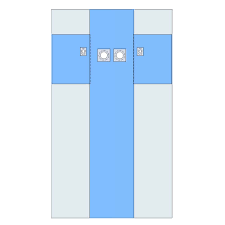
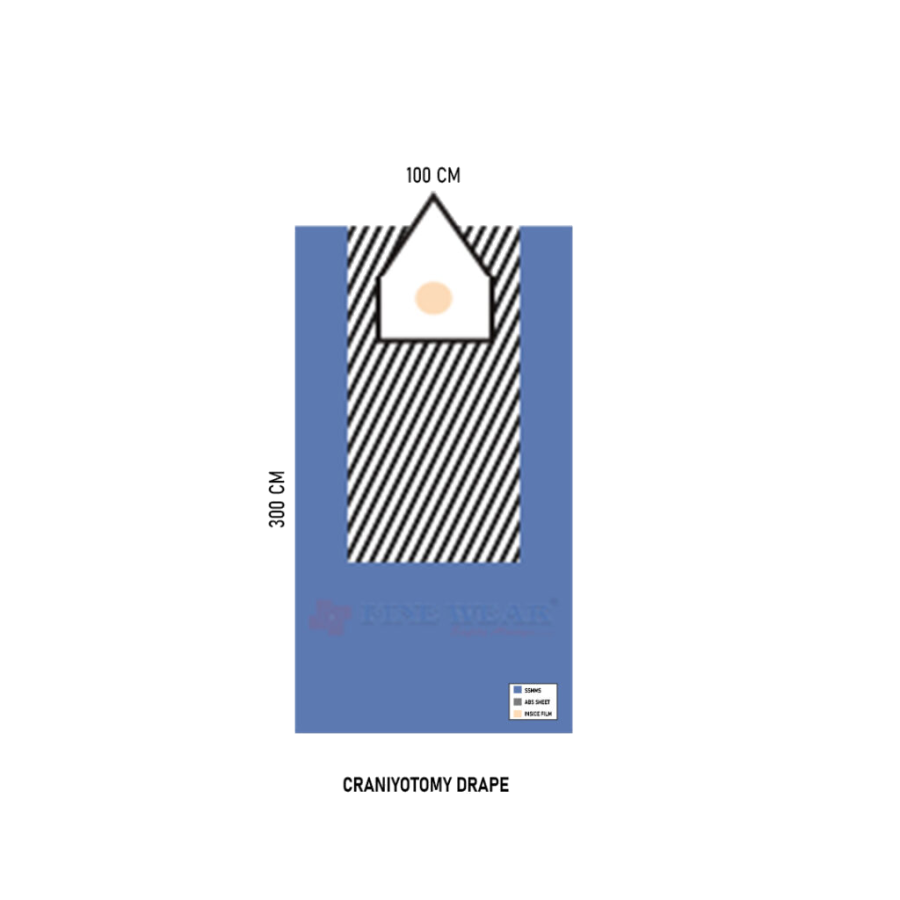
A typical table cover drape is made from polyethylene film, which provides the impervious barrier across the whole sheet, with an absorbent non-woven reinforcement bonded to the central area that lies on the table top. The reinforced zone is where instruments and bowls sit; the plain film beyond it forms the overhang.
How these layers are combined is described more fully in our article on the layers inside a surgical drape.
In many procedure packs the table cover also serves as the pack’s inner wrap. The sterile pack is placed on the trolley, the outer packaging is removed and the wrap is opened outwards to become the table cover, with the remaining contents already resting in the centre.
Fan-folding and how the cover opens
The way a table cover is folded is as important as what it is made from. Covers are fan-folded, that is, pleated back and forth like a concertina, so that the sheet opens outwards in stages with a light pull and does not have to be shaken out. The folds are arranged so that a cuff or turned-back edge is presented first.
The general sequence is consistent, although local teaching should always be followed:
- The folded cover is placed on the centre of the trolley with the direction markings facing the right way.
- The first folds are opened away from the person, so that the far side is covered before the near side.
- The near side is then opened towards the person, protecting the front of the gown or, for a circulating nurse, avoiding any reach across the sterile surface.
- The cover is allowed to fall over the edges and is not adjusted upwards once it has dropped.
Sizes and fit
Trolleys vary widely between hospitals, so covers are supplied in a range of sizes and are frequently made to order. As a broad indication only, back table covers are commonly in the region of 140–150 cm wide and 190–230 cm long, with larger sizes for orthopaedic and cardiac set-ups, and mayo stand covers are commonly around 80 cm by 140–145 cm. These are typical catalogue figures, not a standard, and should be checked against the furniture in use.
| Item | Form | Reinforcement | What to measure |
|---|---|---|---|
| Back table cover | Flat rectangular sheet, fan-folded | Absorbent panel over the table-top area | Table length and width, plus the overhang wanted on each side |
| Large table cover | As above, in larger dimensions | Longer panel for implant trays | Combined length where two trolleys are joined |
| Mayo stand cover | Bag or sleeve closed at one end | Panel over the tray area, on one or both faces | Tray length and width, and depth of the frame |
| Table cover used as pack wrap | Sheet folded around the pack contents | Central panel positioned beneath the contents | Size of the trolley on which the pack is opened |
The mayo stand cover
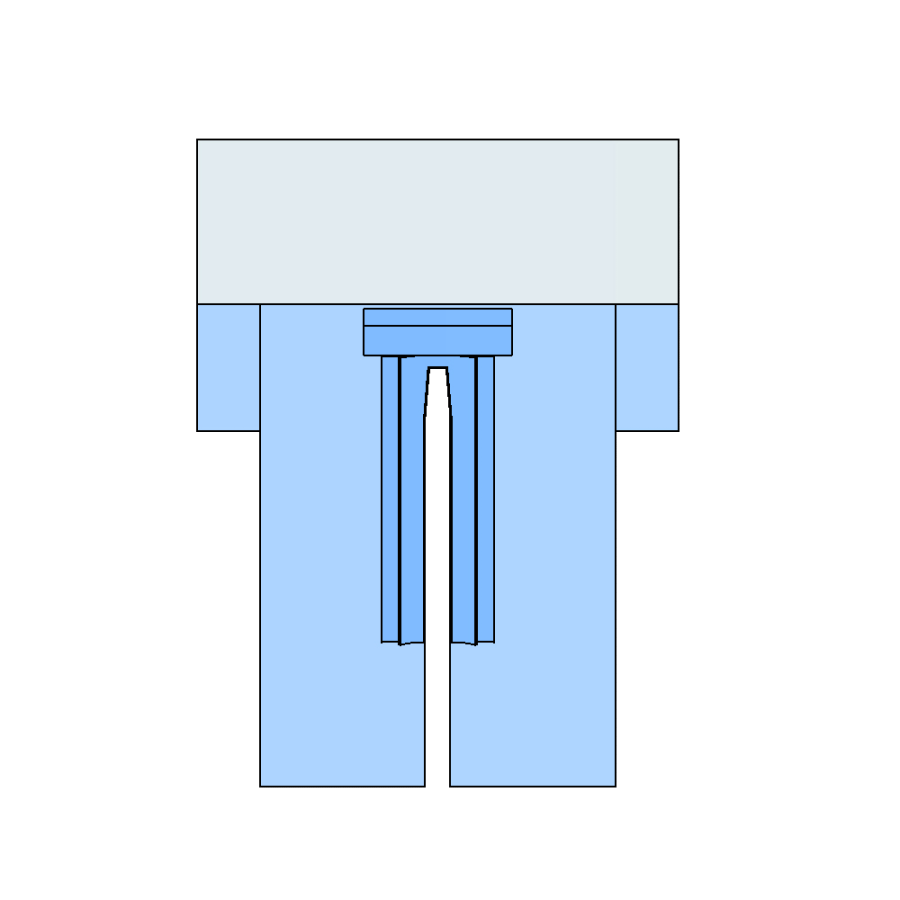
A mayo stand is a tray on a single offset pillar, so that the tray can be brought over the patient. Because the tray is approached from all sides and from above, it is covered with a bag in place of a flat sheet. A mayo stand cover is a long sleeve, closed at the far end, that is drawn over the tray and along the supporting frame.
The cover is folded with a deep cuff. The scrubbed person places both hands inside the cuff, so that the gloves are shielded by the sterile outer surface, and slides the cover over the tray while keeping the folded bulk supported to stop it dropping below waist level. The reinforced absorbent panel ends up on the top of the tray.
What “sterile to table level” means in practice
A principle taught in every theatre is that a draped table is sterile only at table level. The top surface is sterile. The part of the cover that hangs down over the sides is treated as unsterile, even though it came out of the same sterile pack. The reasoning is practical: the hanging portion is out of the team’s line of sight, it brushes against gowns below the waist, trolley frames, legs and equipment, and its condition cannot be monitored.
Several working rules follow from this:
- Anything that falls or slides below the table edge is not brought back up.
- Sutures, tubing and leads are not left hanging over the edge.
- Once the cover is positioned, it is not shifted, since moving it would draw the unsterile overhang up onto the top.
- If the cover is visibly wet through or torn, the barrier is treated as breached.
The same idea applies to the patient drape and to gowns, and it is set out with the other basic rules in our refresher on the principles of the sterile field.
Points for a specification
When table and mayo covers are bought separately or written into a pack, it helps to state the overall dimensions, the size and position of the reinforced panel, the material of the base sheet and the reinforcement, the fold type and direction marking, and whether the items are to be supplied sterile individually or as components of a pack.
Shrisay Medical manufactures table covers and mayo stand covers in Faridabad, in sizes made to order and as components of procedure packs; please contact our team with your trolley dimensions.
Frequently asked questions
Why is only the top of a draped table considered sterile?
The overhanging part cannot be watched and is likely to touch gowns, trolley frames and equipment below waist height, so it is treated as unsterile as a matter of practice.
What is the difference between a back table cover and a mayo stand cover?
A back table cover is a flat sheet laid over a trolley. A mayo stand cover is a sleeve closed at one end that is pulled over the tray and its frame.
Can a table cover also be the wrap of a procedure pack?
Yes. In many packs the inner wrap opens out to become the back table cover, leaving the contents in the centre ready to be arranged.