Key takeaways
- A drape must do two opposite things at once: stop fluid passing through to the patient and hold fluid on its upper surface so it does not run off.
- An impervious film provides the barrier, while an absorbent top layer controls fluid around the incision.
- Reinforcement is concentrated around the fenestration, where fluid, instruments and abrasion are greatest.
- Adhesives, fluid pouches and tube holders are functional components that deserve the same scrutiny as the fabric.
Seen from the surgeon’s side, a drape is a blue or green sheet with an opening in it. Cut through it near that opening and you would find several distinct layers, each chosen for a particular task and bonded to the others. The design problem is harder than it first appears. A gown has to keep fluid out. A drape has to keep fluid from passing through to the patient and the table, and at the same time prevent that fluid from running across its surface and onto the floor or the team. One requirement calls for an impervious material; the other calls for an absorbent one. Layering is how both are met.
The base sheet
The largest part of any drape is its base sheet, which covers the patient and the table and extends the sterile field. Away from the incision, exposure to fluid is low, so the base needs to be light, flexible, strong enough to be unfolded and positioned without tearing, and resistant to the passage of micro-organisms.
Two families of material are common. The first is SMS-type polypropylene non-woven, treated to repel fluid, which is light and conforms well to the patient. The second is a two-layer laminate of a non-woven bonded to a thin polyethylene film, which is fully impervious and is used where a higher barrier is wanted across the whole sheet. The choice depends on the procedure, the barrier standard to be met and the buyer’s preference.
Drapability is an underrated property of the base sheet. A stiff drape tents over the patient, slides and leaves gaps at the edges; a soft one settles into place and stays there.
The film: the impervious line of defence
Where liquid must not pass, a continuous plastic film does the work. Polyethylene film is the usual choice because it is impervious, flexible, inexpensive and compatible with common sterilisation methods. Unlike a porous non-woven, it does not depend on repellency, so pressure and prolonged wetting do not drive fluid through an intact film.
Film on its own would make a poor drape surface: it is slippery, it does not absorb, and fluid beads and runs straight off it. It also needs mechanical support. So the film is laminated to a non-woven, either by an adhesive, by heat, or by extruding the molten film directly onto the web. In a drape the film normally sits underneath, or in the middle, facing the patient side of the absorbent layer.
Since the patient is covered rather than working, breathability is much less of a concern than in a gown, and non-breathable films are generally acceptable. Patient temperature management is addressed by clinical measures under hospital protocol.
The absorbent top layer
The surface that faces the surgical team around the incision is usually absorbent. Its purpose is fluid control: blood and irrigation fluid that land on it are taken up and held instead of flowing away from the site.
Materials used include hydrophilic-treated polypropylene non-woven, viscose or other cellulose-based non-wovens, and spunlace blends. What matters in practice is how quickly the surface takes up fluid, how much it can hold, and whether it stays intact and low-linting when wet and rubbed by instruments and hands.
Combined with the film below, this gives the classic construction of the critical area: fluid is absorbed at the top and stopped at the bottom. Drapes built this way are often called bi-laminate or tri-laminate, according to whether there are two or three bonded layers.
Reinforcement around the fenestration
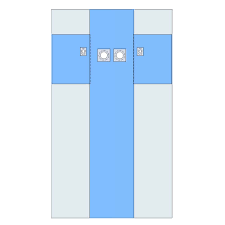
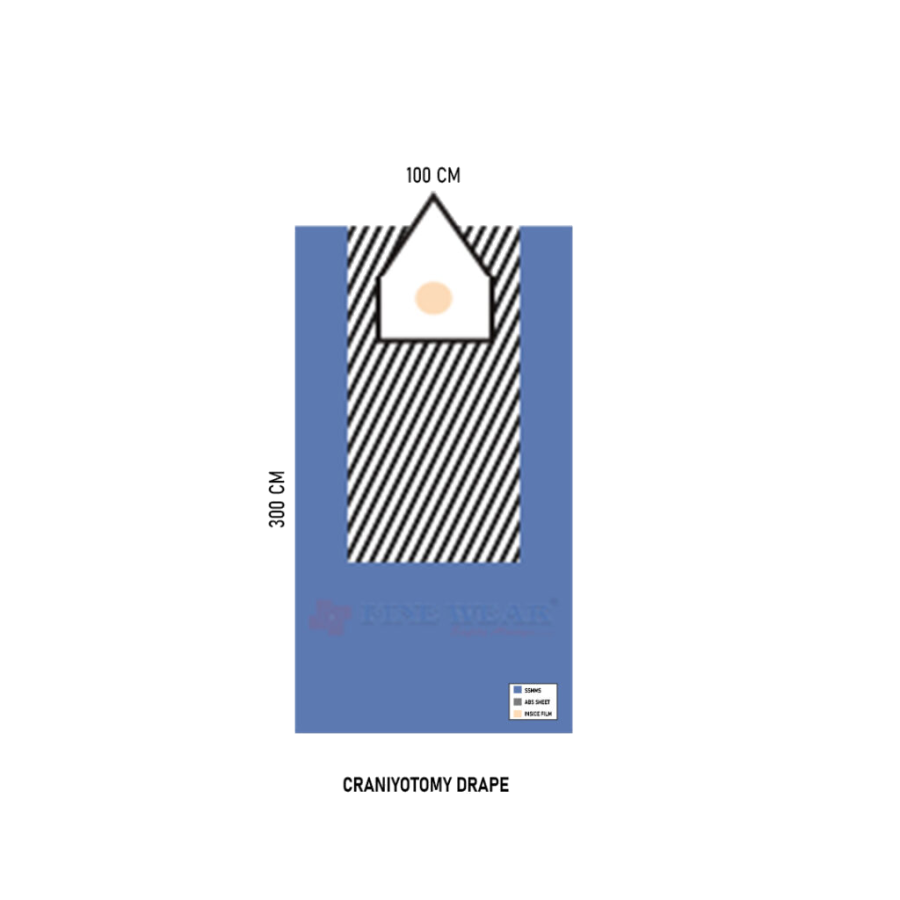
The fenestration is the opening through which the surgeon operates, and the area surrounding it takes almost all the punishment: the greatest fluid volume, the pressure of hands and retractors, instruments laid down and picked up, and constant abrasion. Most drapes therefore carry an additional reinforcement panel around the fenestration, bonded on top of the base sheet.
The size and shape of this panel are a matter of design. A panel that is too small lets fluid run off its edge onto the less protected base. One that is unnecessarily large adds stiffness and cost. Its dimensions, and those of the fenestration itself, are among the most common points of customisation in our surgical drapes.
The layers at a glance
| Layer or component | Typical material | Function |
|---|---|---|
| Base sheet | SMS-type non-woven, or non-woven and PE film laminate | Covers patient and table; microbial and fluid barrier |
| Barrier film | Polyethylene film | Impervious layer preventing strike-through |
| Absorbent top layer | Hydrophilic non-woven, viscose or spunlace | Takes up and holds fluid near the incision |
| Reinforcement panel | Absorbent and film laminate added over the base | Extra barrier, absorbency and abrasion resistance at the fenestration |
| Adhesive strip or border | Medical-grade pressure-sensitive adhesive with a release liner | Fixes the drape edge to the skin and seals the site |
| Incise film | Thin transparent adhesive film | Covers skin at the incision site, where specified |
| Fluid collection pouch | Clear polyethylene film, often with a drainage port | Captures run-off in high-fluid procedures |
Adhesives, pouches and other functional parts
Several components that are not fabric at all strongly affect how a drape performs.
- Adhesive edges. A strip of skin-contact adhesive around or beside the fenestration holds the drape to the prepared skin, so the opening does not migrate and fluid cannot track underneath. The adhesive must hold on skin that has been prepared with antiseptic and still release without undue trauma. Its release liner should peel away easily with gloved hands.
- Fluid collection pouches. In procedures with heavy irrigation or large fluid volumes, such as arthroscopy, urology and caesarean section, a clear film pouch is built into the drape to catch run-off. Many have a mouldable rim to keep the pouch open and a port for suction or drainage.
- Tube and cord holders. Hook-and-loop tabs or perforated tabs keep suction tubing, diathermy leads and camera cables in place.
- Elastic or stretch fenestrations. For limbs, an elastic film opening grips the extremity and forms a seal.
Specifying a drape by its layers
When reviewing a drape, ask the supplier to describe the construction zone by zone rather than giving one material name for the whole product. Useful questions include: what the base sheet is; what the reinforcement consists of and how large it is; which face is absorbent; which barrier standard and performance level the critical area has been tested to; what type of adhesive is used and where; and whether dimensions, fenestration and attachments can be altered. Evaluate samples wet as well as dry, since that is how they will be used.
Shrisay Medical manufactures surgical drapes in Faridabad with sizes, fenestrations and components customised to the procedure; drapes can also be supplied as part of complete procedure kits and packs.
Frequently asked questions
Why does a surgical drape need both absorbent and impervious layers?
The absorbent layer holds fluid near the incision so it does not run off, while the impervious film beneath stops that fluid passing through to the patient and table.
What is a bi-laminate or tri-laminate drape?
The terms describe the number of bonded layers in the drape material. A bi-laminate typically pairs a non-woven with a film, and a tri-laminate adds a third layer such as an absorbent top surface.
Can the reinforcement and fenestration be customised?
Yes. The size, shape and position of the fenestration and its reinforcement panel are commonly adapted to the procedure and the surgeon’s preference.