Key takeaways
- An angiography drape is very long because withdrawn wires and catheters need a sterile surface to lie on.
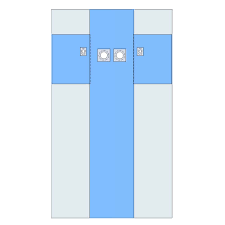
- Aperture layout follows the access route: groins for femoral work, wrist over an arm board for radial, or all four in a combined drape.
- Clear side panels let the operator see and use the table controls without reaching under the sterile field.
- Absorbent reinforcement around each aperture keeps blood, saline and contrast from spreading across the working surface.
The catheterisation laboratory is an unusual sterile environment. The wound is a puncture a few millimetres across, yet the sterile field is one of the longest in the hospital, because the devices passed through that puncture are long, flexible and easily contaminated. An angiography drape is designed around this mismatch: very small openings in a very large sheet.
What follows describes the common features of drapes for coronary and peripheral angiography and for interventional work done by the same route. Access site, patient positioning and the draping sequence remain matters for the operator and the unit’s protocol.
Why the drape runs the full length of the table
Catheters used for coronary work are typically around a metre long, and exchange-length guidewires can be well over two metres. When a wire is withdrawn from the patient, its free end has to lie somewhere sterile. That place is the drape over the patient’s legs and the foot of the table, which serves as the operator’s working surface for the whole procedure.
Three further features of the room push in the same direction:
- The table moves. A cath lab table top floats and is panned under the X-ray system, so the drape must stay in place and keep its edges below table level as the patient travels.
- The detector moves. The C-arm rotates around the patient and the detector is brought close to the chest. The drape has to lie flat, without tented folds that could catch.
- The operator stands to one side. Generous width is needed on the working side, so that wires and catheters that slide off the patient remain on a sterile surface.
A sheet that covers the patient from the upper chest to beyond the feet, with enough drop on both sides, is therefore the starting point of any angiography drape.
Fenestrations for femoral and radial access
The femoral artery in the groin was for many years the standard route for cardiac catheterisation. Access through the radial artery at the wrist is now widely used for coronary procedures, with the choice depending on the patient, the procedure and operator preference. Many units prepare more than one site so that a second route is available if the first fails, and the drape has to allow for this.
| Drape layout | Openings | Suited to | Points to check |
|---|---|---|---|
| Femoral | Two small apertures, one over each groin | Femoral coronary and peripheral work | Spacing between apertures across the patient size range |
| Radial | One or two apertures at the wrist, positioned over an arm board | Radial coronary procedures | Arm board position used in your lab; left or right radial |
| Combined femoral and radial | Four apertures: both groins and both wrists | Units that want every route available from one drape | Unused apertures must stay covered and sealed |
| Brachial or other access | Aperture positioned to order | Selected peripheral and electrophysiology work | Agree the position against a drawing before ordering |
The apertures themselves are small, commonly round or oval, and surrounded by adhesive so that the drape is fixed to the prepared skin and blood cannot track underneath. Many designs fill the aperture with a transparent adhesive film through which the puncture is made. Unused apertures normally remain closed by their film or by a removable cover. The different aperture types and the role of adhesive are described in our guide to fenestrated drapes.
Radial access changes the geometry. The arm lies on a board beside the patient, and the working surface runs from the wrist down along the patient’s side and legs. A radial drape needs enough material around the arm to cover the board fully and to bridge the gap between arm and body.
Clear panels and table controls
The operator moves the table and the imaging system from a control panel mounted on the table’s side rail. If an opaque drape hangs over it, either the controls are worked blind or someone reaches under the sterile sheet.
Angiography drapes commonly solve this with transparent polyethylene panels along one or both long edges. The panel hangs over the controls so that they can be seen and operated through the film. The points to settle with a supplier are which side the panels are needed on, how long they are, and where they start in relation to the apertures, since control positions differ between installations. A separate sterile cover for the radiation shield and for the detector is usually supplied alongside, as outlined in our article on equipment covers in the sterile field.
Absorbent zones and fluid
Angiography produces far less fluid than open surgery, but it is not a dry procedure. Blood escapes at the sheath during exchanges, catheters are flushed repeatedly with saline, and contrast medium is sticky when it dries. Wet patches on a smooth film surface let wires slide and make gloves tacky.
For this reason the area around each aperture is usually reinforced with an absorbent layer over an impervious backing, while the remainder of the sheet is a lighter fluid-repellent non-woven. A long case, such as a complex intervention, deserves more attention to the barrier than a short diagnostic study, because the same reinforced area stays wet for much longer.
What an angiography pack contains
Because a unit performs the same procedure many times a day, the drape is normally supplied inside an angiography pack with the other single-use items needed to set up. Contents vary with the lab, but commonly include:
- the full-length angiography drape;
- a table cover for the instrument trolley, which often doubles as the pack’s outer wrap;
- surgical gowns and hand towels;
- bowls or basins for saline and for wetting guidewires, and smaller pots for contrast and local anaesthetic, as specified;
- gauze swabs and a small drape or towel for the access site;
- covers for the detector, the radiation shield and the control panel.
Needles, sheaths, wires and catheters are generally selected per case and opened separately.
Specifying an angiography drape
A written specification or a sample request should cover at least the following:
- Overall length and width, checked against the table and the tallest patients expected.
- Number, size and position of apertures, with the distances between them.
- Whether apertures are open, adhesive-edged or film-covered.
- Side and length of clear panels.
- Extent of the absorbent reinforcement.
- The barrier standard and level claimed, and the evidence for it.
- Fold and orientation marking, so that the drape opens the right way round at the first attempt.
The last point is easily overlooked. A drape of this length that is opened head to foot the wrong way cannot be turned round without contaminating it, so clear direction markings and a consistent fold save both time and stock.
Shrisay Medical manufactures angiography drapes and packs in Faridabad, with aperture positions, clear panels and pack contents made to order; for a layout matched to your cath lab, please get in touch.
Frequently asked questions
Why do some angiography drapes have four openings?
A four-aperture drape gives access to both groins and both wrists from one sheet, so a second route is available without redraping. Unused apertures stay sealed.
What are the clear plastic panels on the side of the drape for?
They hang over the table-side control panel so the operator can see and operate the table and imaging controls through the sterile film.
Are catheters and guidewires included in an angiography pack?
Usually not. Packs generally hold the drape, covers, gowns, bowls and swabs, while access devices are chosen for each case and opened separately.