Key takeaways
- Equipment that cannot be sterilised but enters the sterile field is isolated with a sterile single-use cover.
- Fit is the main selection criterion: a cover must match the make and dimensions of the equipment it is used on.
- Covers are usually clear polyethylene film, folded so that a scrubbed person can apply them without touching the equipment.
- A torn, slipped or wet-through cover is a break in the sterile field and is managed according to hospital protocol.
Modern surgery brings a good deal of machinery to the table. An endoscopic camera head is held in the surgeon’s hand, the arc of a C-arm swings over the wound, and an operating microscope hangs centimetres above an open field. None of these can go through a steriliser between cases, and wiping with disinfectant does not make them sterile. The accepted solution is to enclose the part that enters the sterile field in a sterile, single-use cover. These covers are simple products, but a poor choice causes real difficulty: glare in the optics, a cover that slips mid-case, or a tear nobody notices.
What an equipment cover has to do
- Provide a barrier between a non-sterile device and the sterile field, in both directions: it also keeps blood and fluid off equipment that is difficult to clean.
- Allow the device to function. The image must stay clear, controls must be usable through the cover, and moving parts must move.
- Go on aseptically. The fold must let a scrubbed person apply it without touching the device, usually with a circulating colleague’s help.
- Stay on. Tapes, ties or elastic hold it against movement and gravity for the whole procedure.
- Tolerate heat. Light sources and motors warm up, so the material and fit must allow for it.
Covers by equipment type
Camera covers
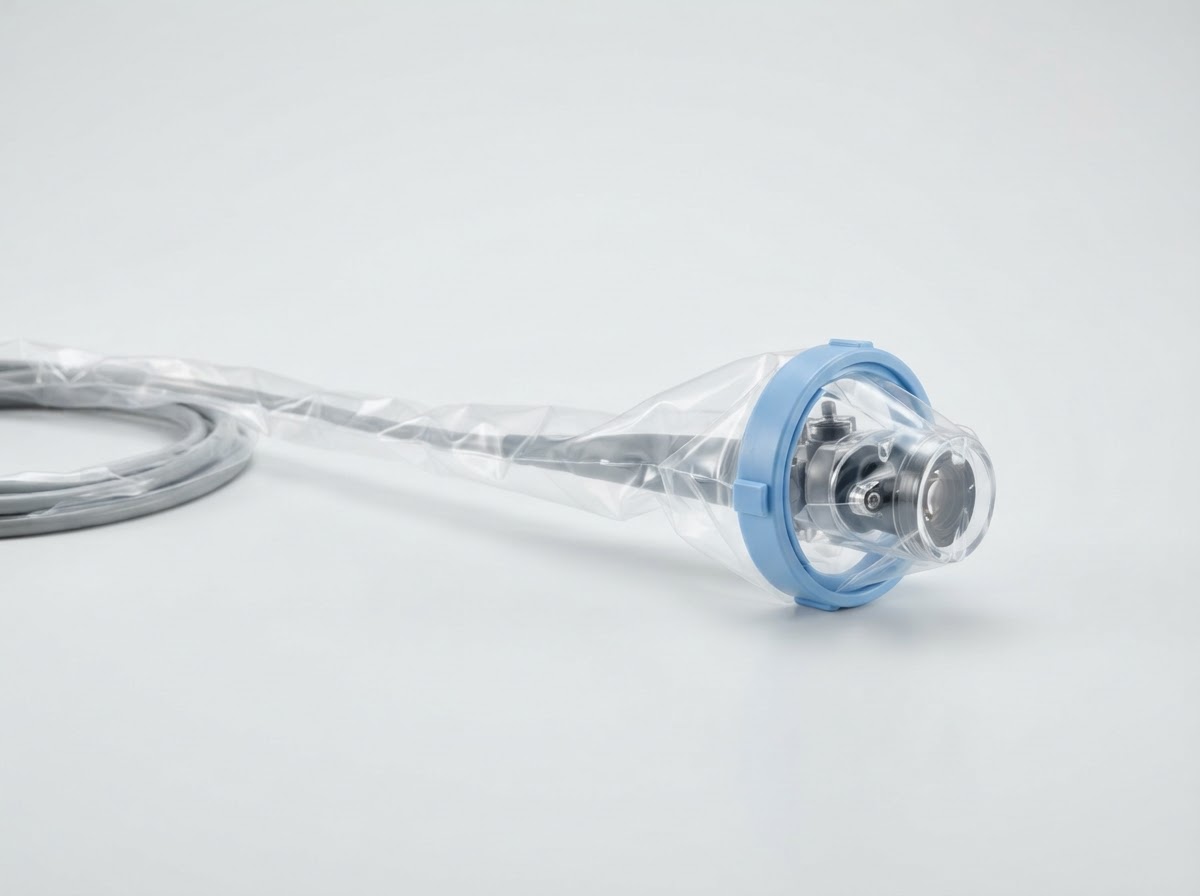
A camera cover, sometimes called a camera sleeve or laparoscopy camera drape, is a long narrow tube of clear film that encloses the camera head and a length of its cable. The scrubbed assistant typically holds the cover by its sterile end while the circulating nurse passes the camera head in or connects it; the sleeve is then extended along the cable, away from the field, and secured with adhesive tape strips. Many designs have a telescopic or concertina fold and a card or plastic ring at the open end to make this easier.
Designs differ at the tip. Some have a closed end, others an opening or an elasticated or perforated tip through which the sterile telescope couples to the camera. Which is appropriate depends on the camera system and on how the hospital reprocesses its scopes and camera heads, so the choice should follow the device manufacturer’s instructions and local policy. Typical lengths run to around two and a half metres so that enough cable is covered to reach beyond the edge of the field; length and width are customisable.
C-arm drapes
The mobile image intensifier is a large object with an awkward shape, and it moves during the case, rotating around the patient between views. Covers come in several forms:
- Image intensifier and tube covers: elasticated round “shower cap” style covers for each end of the arc.
- Full C-arm covers: a shaped sleeve covering the intensifier, the arc and the X-ray tube in one piece or as a set, usually with elastic and tape fastenings.
- Combination drapes: for procedures such as hip fracture fixation, a large vertical isolation drape separates the surgeon’s sterile side from the C-arm, which then works from the non-sterile side without needing a full cover.
The main risk with a C-arm is contamination during movement. The lower end of the arc passes beneath the table, through a non-sterile zone, and may then be rotated back up. Teams should agree how that end is managed, and many re-cover or avoid contact after each swing, as their protocol directs. Measure the intensifier diameter and arc dimensions for the model in use before ordering; mini C-arms need their own size.
Microscope drapes
The operating microscope drape is the most complex of the three, because the microscope has several projections: the objective, binocular eyepieces for the surgeon, often an assistant’s observer tube, a camera port and the handles. The drape is a large clear film bag with separate pockets or sleeves for these, and a lens housing at the objective.
That lens housing is the critical part. It carries a clear optical window through which the surgeon views the field, and its diameter must match the objective of the specific microscope. Because reflections from the light source can degrade the view, the window is commonly set at a slight angle or made removable, according to design. Elsewhere on the drape, straps or adhesive strips gather excess film so that it does not hang into the field or obstruct the view, and care is taken not to wrap the light source housing so tightly that heat cannot escape. Ophthalmic, ENT, neurosurgical and spinal microscopes differ in configuration, and a drape is ordered by microscope make and model.
Summary of selection points
| Cover | Typical construction | Key points to specify |
|---|---|---|
| Camera cover | Clear film sleeve, telescopic fold, tape strips | Length, width, tip style, ring or card applicator |
| C-arm cover | Clear film, elasticated caps or shaped sleeve, tapes | Intensifier diameter, arc size, full or partial coverage |
| Microscope drape | Clear film with eyepiece sleeves and lens housing | Microscope make and model, lens diameter, number of eyepiece ports |
| Other covers | Film or non-woven, shaped to the item | Dimensions of probes, light handles, cables, Mayo stands or tables |
Application and checks during the case
- Check the pack for integrity and expiry, and confirm it is the right cover for the device.
- Follow the fold: arrows or printed markers usually show where to place the hands and which way to extend.
- Keep gloved hands inside the cuff or on the sterile outer surface as the manufacturer’s instructions show.
- Secure tapes and ties so that the cover cannot slide towards or away from the field.
- Before use, check the image or view; a wrinkle over a lens is easier to correct now than later.
- Inspect the cover periodically. If it is torn or displaced, inform the team and replace or re-cover as hospital protocol directs.
What to ask your supplier
Give the supplier the make and model of each piece of equipment and ask for samples to test on the device itself before committing to volume. Ask about film thickness and clarity, the sterilisation method, how the cover is folded, and whether covers can be included in your procedure packs so that they arrive at the table with the drapes. Shrisay Medical supplies equipment covers within its accessories and apparel range and can build them into customised kits and packs, with sizes made to the equipment in use.
Frequently asked questions
Why does equipment need a sterile cover if it has been disinfected?
Disinfection reduces contamination but does not make a device sterile. Equipment that enters the sterile field and cannot be sterilised is therefore enclosed in a sterile cover.
How do I choose the right microscope drape?
Order by the make and model of the microscope, paying particular attention to the objective lens diameter and the number of eyepiece and observer ports. Test a sample on the microscope before placing a volume order.
What should be done if a C-arm or camera cover tears during a procedure?
A torn cover is a break in the sterile barrier. Inform the team and replace or re-cover the equipment according to your hospital’s protocol.