Key takeaways
- The fenestration should expose the prepared working area and nothing more, with allowance for the incision to be extended.
- Adhesive apertures hold the edge of the sterile field in place; non-adhesive ones suit fragile skin and brief procedures.
- Aperture shape follows the incision: round for punctures, oval or rectangular for linear incisions, slits for limbs and lines.
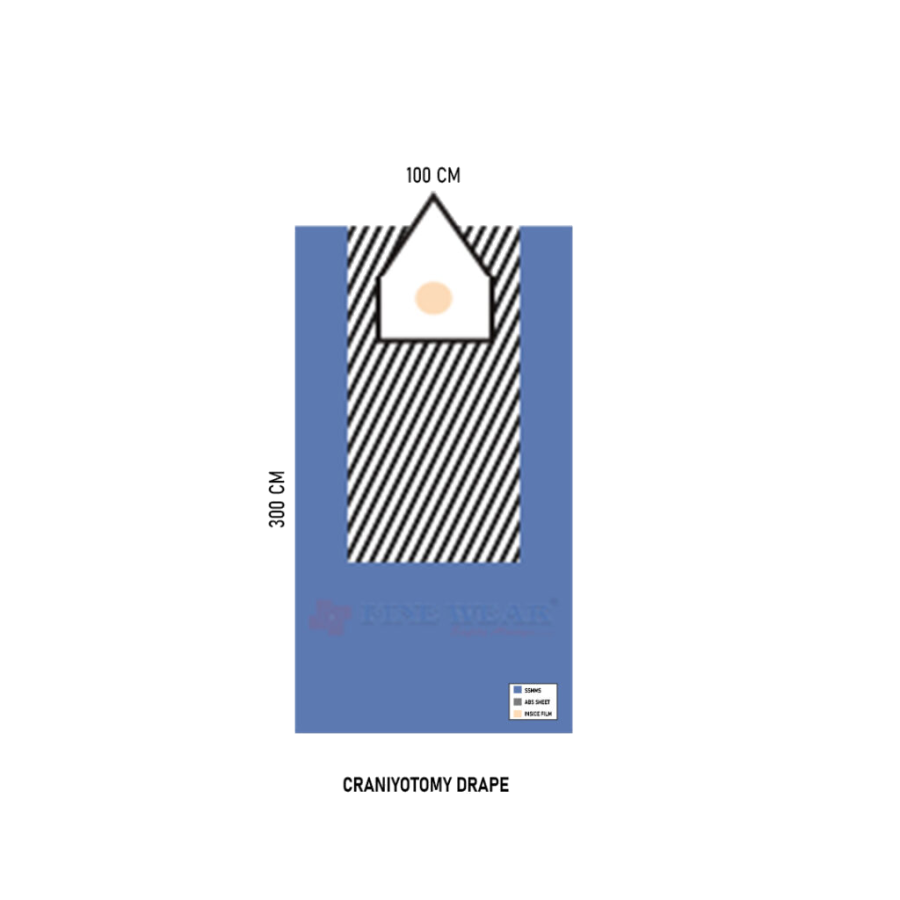
- A dimensioned sketch showing aperture size and its distance from each edge avoids most ordering errors.
A fenestrated drape is a sterile sheet with an opening, the fenestration or aperture, placed over the operative site. It is the simplest way to cover a patient while leaving one defined area exposed, and it appears everywhere from a bedside central line to a major laparotomy. Because the opening is the whole point of the product, the details of that opening deserve more attention than they usually receive at the ordering stage.
What the fenestration has to achieve
The aperture marks the boundary between prepared skin that may be touched and everything that must stay covered. A well-chosen fenestration:
- exposes the planned incision or puncture site with a sensible margin, including room to extend the incision if the procedure requires it;
- lies entirely within the area of skin that has been prepared with antiseptic;
- stays in position when the patient is moved, the table is tilted or the team leans on the drape;
- does not gape as the drape is pulled, which would expose unprepared skin at the edges.
If the opening is too small, staff stretch or cut it, which damages the barrier and sheds particles. If it is too large, the benefit of a defined field is lost. Neither problem can be corrected once the drape is on the patient.
Aperture shapes and what they suit
| Aperture | Typical applications | Points to note |
|---|---|---|
| Round | Injections, biopsies, lumbar puncture, vascular access, minor excisions | Small diameters; often on a compact drape for ward or clinic use |
| Oval | Eye surgery, ENT, small linear incisions, hernia repair | Follows a short incision without exposing excess skin at the corners |
| Rectangular | Laparotomy, caesarean section, spinal and thoracic surgery | Allows a long incision and its extension; usually reinforced |
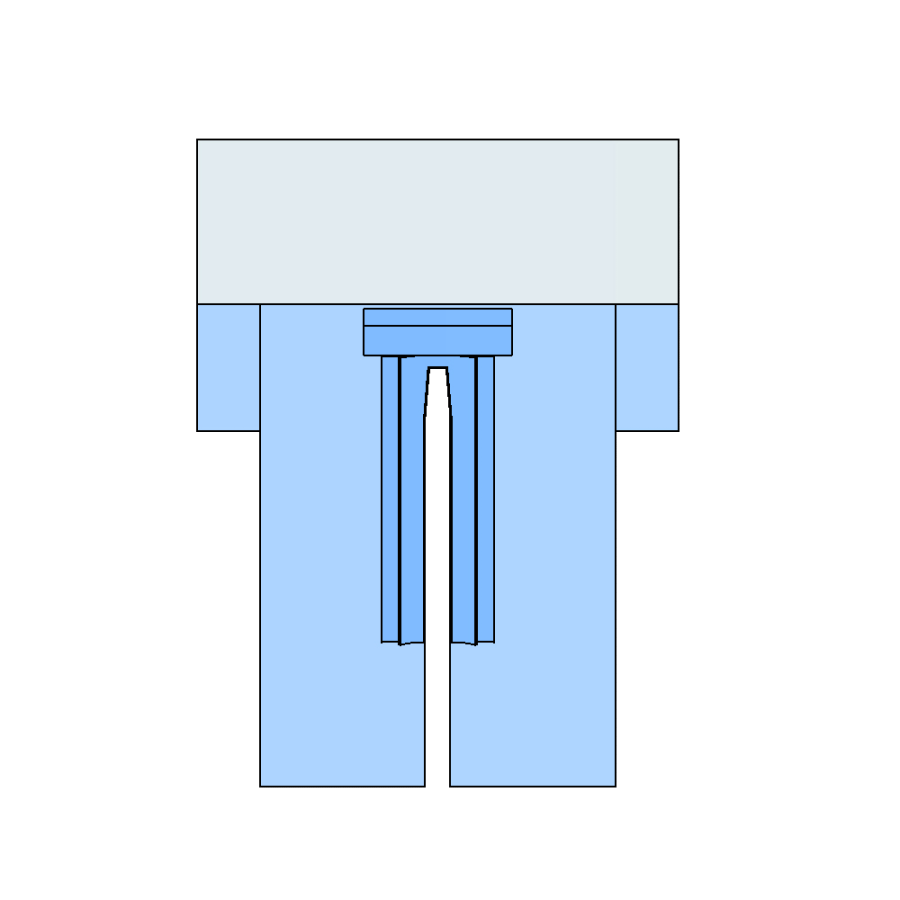
| Slit or keyhole | Passing a limb, catheter, drain or line through the drape | May run to the drape edge so it can be placed around something already in position |
| Elasticated opening | Extremity drapes for hand, foot, arm and leg | A stretch film or elastic collar grips the limb and seals around it |
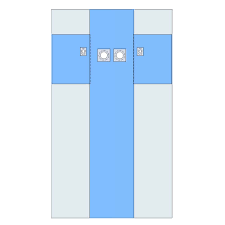
| Multiple apertures | Combined abdominal and perineal access, bilateral procedures, angiography | Positions must match patient anatomy and table set-up closely |
Dimensions quoted in catalogues are typical rather than fixed. Patient populations and surgical habits differ between hospitals, and aperture size is one of the features most often altered to order.
Adhesive versus non-adhesive apertures
An adhesive fenestration has a band of medical-grade adhesive on the underside around the opening, protected by a release liner that is peeled away just before placement. Once pressed down, the drape edge is fixed to the skin. This has three practical effects. The aperture cannot drift away from the site. Fluid is less able to track under the drape edge onto unprepared skin. And the team does not need towel clips, which puncture the drape and, if misapplied, the patient.
A non-adhesive fenestration simply lies on the skin. It is quicker to place and remove, causes no adhesive trauma, and costs less. Its weakness is movement: the opening can shift when the drape is tugged, so it relies on the weight of the drape and on a still patient.
In general terms, adhesive apertures are preferred when the procedure is longer, when fluid is expected, when the patient or table will be repositioned, or when the site is on a curved or sloping surface. Non-adhesive apertures are reasonable for very short procedures on a flat site, for patients with fragile or broken skin, for neonates where local policy restricts adhesives, and where the area cannot be dried adequately. A known sensitivity to adhesives should always be checked. The choice belongs to the clinical team under hospital protocol.
For good adhesion, the skin-prep solution must be completely dry before the liner is removed. Applying adhesive to wet skin gives a poor bond, and trapping alcohol-based solution beneath a drape is a recognised fire risk when diathermy is used.
Edge finishes around the opening
The construction of the aperture edge varies more than the outline suggests.
- Plain cut edge. The opening is die-cut from the base fabric with no added layer. Suitable for dry, minor procedures.
- Reinforced surround. An absorbent or absorbent-plus-impervious patch is bonded around the opening to take up fluid and resist strike-through in the critical zone.
- Incise film window. Transparent adhesive film spans the opening, and the surgeon cuts through it. Skin up to the wound edge stays covered.
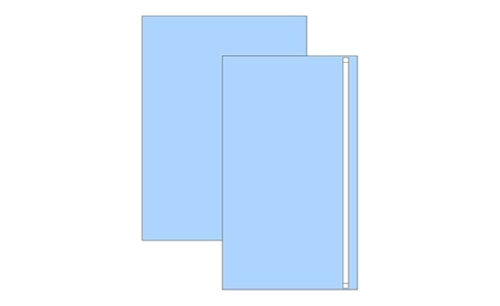
- Split adhesive liner. The release paper is divided into sections so the drape can be positioned first and then stuck down one side at a time, which helps on larger drapes.
- Integrated pouch. A fluid collection pocket sits directly below or around the opening.
Getting size and position right
Position matters as much as size. On a large drape, the aperture is rarely in the centre: an abdominal drape needs more length towards the feet than towards the head, and a drape for a lateral approach is offset to one side. When a fenestrated drape is ordered by overall dimensions alone, the opening may end up in the wrong place for the table and the anaesthetic screen.
The most reliable method is to have theatre staff measure during a real case: the incision length, the prepared margin wanted around it, and the distance from the centre of the incision to the head end, foot end and each side at the drop required. Those figures translate directly into a drawing. Small fenestrated drapes for ward procedures are also commonly included in procedure kits for dressing, catheterisation and line insertion, where the same care over aperture size applies.
What to tell your supplier
A clear enquiry for a fenestrated drape includes:
- the procedure and patient position;
- overall drape size and material, or the barrier level required;
- aperture shape and dimensions, and its distance from each edge;
- adhesive or non-adhesive, and whether a split liner is wanted;
- reinforcement, incise film or pouch around the opening;
- sterile single-packed, or non-sterile for inclusion in a pack.
Shrisay Medical produces fenestrated drapes with apertures cut to the customer’s drawing; a rough sketch with measurements is enough to begin, and you can share it with us here.
Frequently asked questions
What does fenestrated mean in a surgical drape?
It means the drape has an opening, called a fenestration or aperture, that exposes the operative site while the rest of the patient remains covered.
Can a fenestration be cut larger in theatre?
It is poor practice. Cutting or stretching the opening can damage the barrier, release fibres and remove any adhesive or reinforcement, so the correct size should be specified in advance.
Is an adhesive aperture always better?
No. Adhesive keeps the opening in place and limits fluid tracking, but a non-adhesive aperture can be more appropriate for fragile skin or very brief procedures, as decided under hospital protocol.