Key takeaways
- A visitor or cover gown keeps everyday clothing away from the patient and surroundings; it is non-sterile and offers minimal liquid barrier.
- Spunbond polypropylene suits routine visits, while SMS gives more splash resistance and opacity where contact is closer.
- A visitor gown is not a substitute for an isolation gown with a stated barrier level when staff give care under contact precautions.
- Each gown is for one visit to one patient, and hospital policy decides which visitors are asked to wear one.
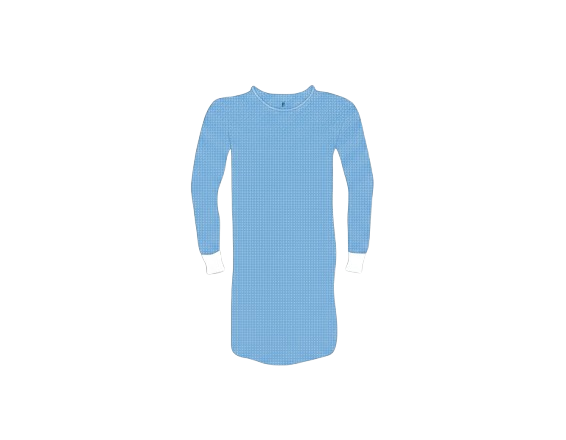
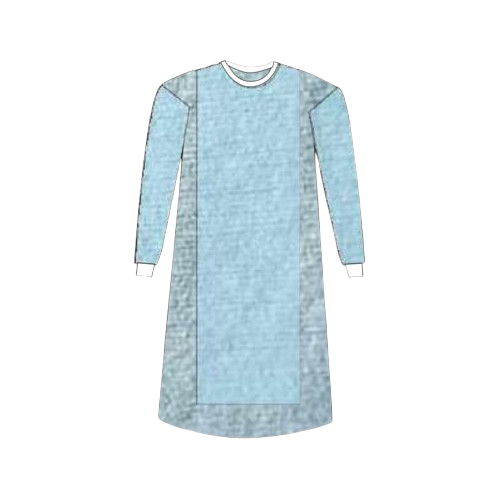
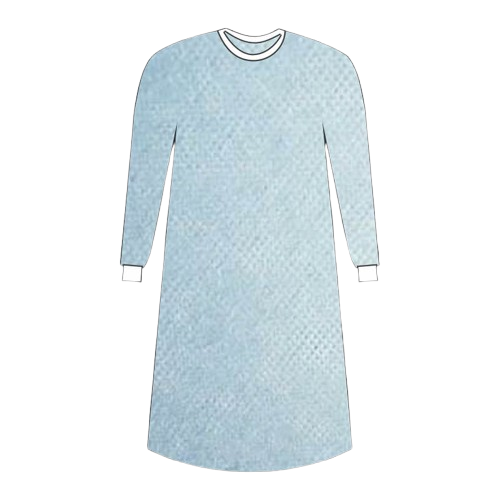
At the door of many intensive care and neonatal units there is a dispenser of thin gowns, usually blue or green, which relatives are asked to put on over their clothes. Staff from other departments, engineers and students passing through often wear the same garment. It goes by several names: visitor gown, cover gown, over-gown.
It is among the simplest products in the gown family, and it is also one of the most often misunderstood, both by those who expect too much of it and by those who buy it against a specification written for something else.
What a cover gown is for
The purpose is modest and specific: to place a clean, single-use layer between a person’s everyday clothing and the patient and the patient’s immediate surroundings. Street clothes have been on public transport, in waiting rooms and at home, and sleeves and shirt fronts brush against beds, incubators and equipment when a visitor leans in.
A cover gown is not intended to protect the wearer from heavy exposure to blood or body fluids, and it is not sterile. It also does very little on its own. Hand hygiene on entering and leaving is the measure with the strongest support, and a gown worn over unwashed hands gives a false sense of having done what is needed.
Protection level and materials
In terms of liquid barrier, visitor gowns sit at the lowest end of the range. Under ANSI/AAMI PB70, Level 1 describes minimal barrier performance, and visitor cover gowns are among the uses commonly associated with it; many visitor gowns are sold with no barrier classification at all. Our guide to AAMI PB70 Levels 1–4 explains what each level is tested for.
Two materials account for almost all of them:
- Spunbond polypropylene (PP) — a single-layer non-woven that is light, breathable and inexpensive. It keeps dust and dry contact off the clothing beneath and resists a light splash briefly, but liquid will pass through under pressure or with time.
- SMS polypropylene — spunbond, meltblown and spunbond layers bonded together. The meltblown middle layer improves resistance to liquid and to fine particles, and the fabric is more opaque and somewhat stronger for a given weight.
Spunbond is adequate for a routine family visit. SMS is the more reasonable choice where the wearer will handle the patient, where some splash is plausible, or where the unit wants one gown that can serve visitors and low-risk staff tasks alike.
Design features
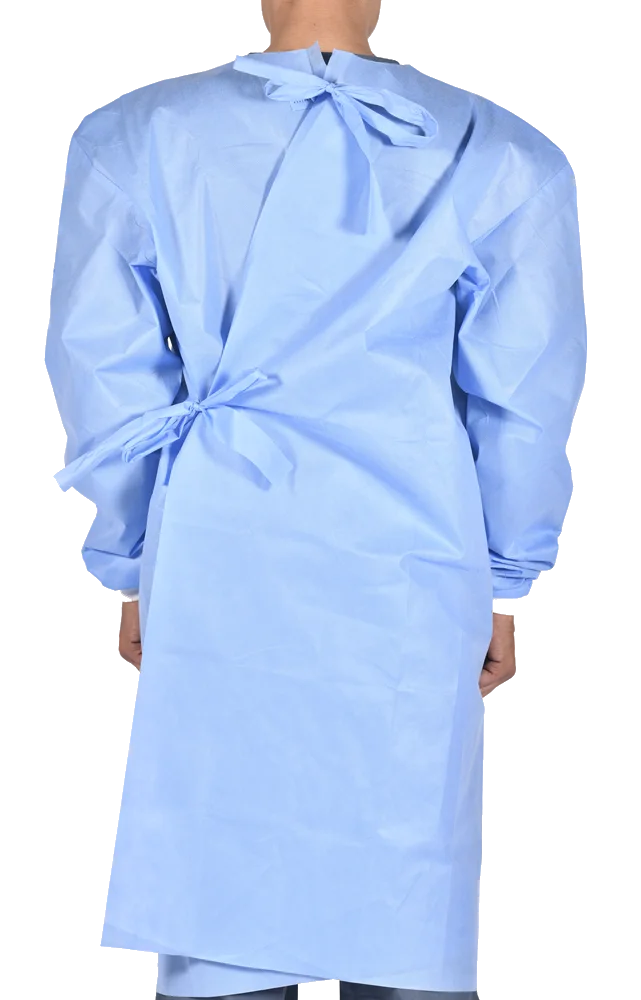
- Back opening with ties at neck and waist, so the front is a continuous surface.
- Long sleeves with elastic or knitted cuffs that keep the sleeve at the wrist when the wearer reaches into a cot or across a bed.
- Length to the knee or below, covering clothing when the wearer sits beside the bed.
- A generous free size, since visitors cannot be fitted individually and are often wearing bulky clothes underneath.
- Simple to put on unaided. Visitors are not trained staff; if the gown is confusing, it will be worn open or back to front. Clear instructions at the dispenser help.
How it differs from an isolation gown
The two garments look alike, and the same pattern in a heavier fabric can serve as either. The difference is in purpose and in what is claimed.
| Point | Visitor or cover gown | Isolation gown |
|---|---|---|
| Main purpose | Keep everyday clothing away from the patient and surroundings | Protect the wearer and limit spread under contact precautions |
| Typical wearer | Relatives, visiting staff, contractors | Clinical staff giving direct care |
| Barrier claim | Minimal, or none stated | A stated level chosen for the expected exposure |
| Typical fabric | Spunbond PP or light SMS | SMS, or coated and laminated fabrics for higher levels |
| Seams and coverage | Basic construction | Whole garment, including seams, expected to meet the claimed level |
| Sterility | Non-sterile | Usually non-sterile |
The practical consequence is that a visitor gown should not be substituted for an isolation gown when a member of staff is caring for a patient under contact precautions or expects splashing. For that work, a garment such as an SMS isolation gown with a stated barrier level is the appropriate item. The design differences are covered more fully in our article on surgical gowns and isolation gowns.
One visit, one gown
A cover gown is a single-use item in the fullest sense:
- It is put on at the entrance to the unit or bed space, after hand hygiene.
- It is worn for one visit to one patient.
- It is removed before leaving, by unfastening the ties and peeling it away from the body so that it turns inside out, and placed in the bin provided.
- Hands are cleaned again.
Hanging a used gown on a hook for the next visit, or wearing the same gown from one bed to another, defeats the purpose and can turn the gown into a means of carrying contamination. If a unit finds that gowns are being reused because of supply or cost, the better response is to review who really needs one.
Who gowns is a policy decision
There is no single rule on visitor gowning, and practice varies widely between hospitals. Some units ask every visitor to wear a gown; others reserve gowns for visits to patients under contact isolation, for visitors who will hold or handle the patient, or for particular high-risk groups. Published reviews of routine gowning for visitors and attendants in newborn nurseries have not shown a clear reduction in infection from the practice alone, and many infection-control teams now place the emphasis on hand hygiene, on keeping unwell visitors away, and on targeted use of gowns.
That is a matter for each hospital’s infection-control committee, taking account of its patients, its layout and its own surveillance data. In neonatal units the picture is complicated by skin-to-skin care, where the parent’s chest is deliberately uncovered, and by long daily stays by parents; unit policy should say plainly what is expected in each situation.
For the buyer, the policy determines the product. A unit that gowns every visitor needs an economical spunbond gown in large quantities with a dispenser at the door. A unit that gowns selectively may prefer a smaller number of SMS gowns. In either case the specification should state fabric type and weight, dimensions, cuff type, colour and packing, and should not borrow barrier requirements from a surgical gown specification that the product was never meant to meet.
Shrisay Medical manufactures the visitor cover gown in Faridabad, made to order in size, fabric and pack configuration; for samples or quantities, please contact our team.
Frequently asked questions
Are visitor gowns sterile?
No. Visitor and cover gowns are supplied non-sterile, typically in bulk packs. They are clean single-use garments, not part of a sterile field.
Can a visitor gown be reused for the next visit?
No. It should be worn for one visit to one patient and then discarded. Reusing or sharing a gown can carry contamination between people and bed spaces.
Do all ICU and NICU visitors need to wear a gown?
There is no universal rule. Some units gown every visitor and others only in specific situations, so the hospital’s infection-control policy decides.