Key takeaways
- A surgical gown protects a sterile field and the wearer during an operation; an isolation gown protects the wearer and limits cross-contamination during patient care.
- Surgical gowns concentrate barrier performance in the front and forearms, while isolation gowns are expected to protect across the whole garment.
- Surgical gowns are supplied sterile and donned aseptically; isolation gowns are usually non-sterile and put on without assistance.
- The two are not interchangeable, and purchase specifications should name the gown type as well as the barrier level.
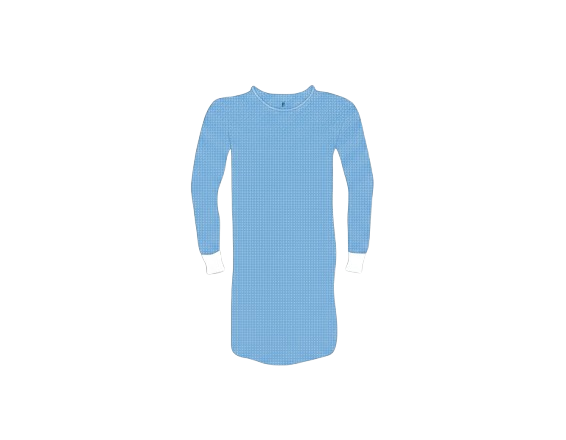
Both garments are long-sleeved, tie at the back and are commonly made from blue or green polypropylene non-woven. That resemblance leads to a recurring procurement problem: a requisition asks for “disposable gowns”, and what arrives is not what the ward or the theatre needed. A surgical gown and an isolation gown answer different questions. One asks how to keep an operative field sterile while protecting the surgeon from the patient’s blood. The other asks how to stop a care worker carrying contamination from one patient, or one room, to the next.
Two different purposes
A surgical gown is worn by scrubbed members of the operating team during an invasive procedure. It works in two directions at once. It prevents micro-organisms shed from the wearer’s skin and clothing from reaching the wound, and it prevents the patient’s blood and body fluids from reaching the wearer. Because it forms part of the sterile field, it is a sterile product, handled and put on using aseptic technique.
An isolation gown, also called a cover gown or procedure gown, is worn for patient care outside the sterile field: contact precautions, wound care, emergency department work, laboratory handling and similar tasks. Its job is to protect the wearer’s clothing and skin from contamination and to be removed and discarded before the wearer moves on. Sterility is not normally required.
Critical zones: the central design difference
Standards for liquid barrier performance treat the two garments differently because the direction of exposure is different.
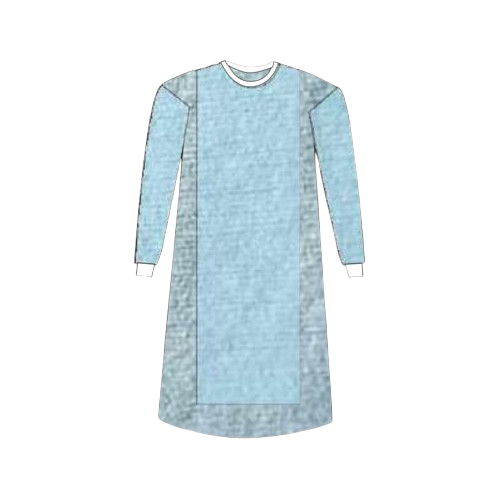
In surgery, the wearer faces the field. Contact with fluid is concentrated on the front of the body between chest and knee and on the sleeves from the cuff to above the elbow. These are the critical zones of a surgical gown, and the stated barrier level applies there. The back does not face the field and, under AAMI PB70, need not be protective; leaving it lighter is how designers release body heat.
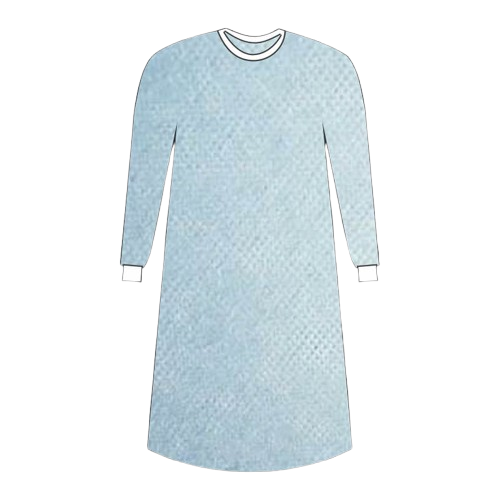
In patient care, exposure is less predictable. A nurse may turn, bend over a bed, be touched from behind or brush against contaminated surfaces. For that reason PB70 treats the entire isolation gown, including its seams, as the critical zone, with limited exceptions for cuffs, hems and bindings. An isolation gown that claims a given level is expected to deliver it all round.
Comparison at a glance
| Feature | Surgical gown | Isolation gown |
|---|---|---|
| Primary purpose | Maintain the sterile field and protect the wearer during surgery | Protect the wearer and limit cross-contamination during care |
| Sterility | Supplied sterile | Usually non-sterile |
| Critical zones | Front, chest to knee, and sleeves to above the elbow | Whole gown, with minor exceptions |
| Back | Wrap-around panel; may be non-protective | Expected to provide coverage and barrier |
| Cuffs | Knitted cuffs to sit under surgical gloves | Elastic or knitted cuffs |
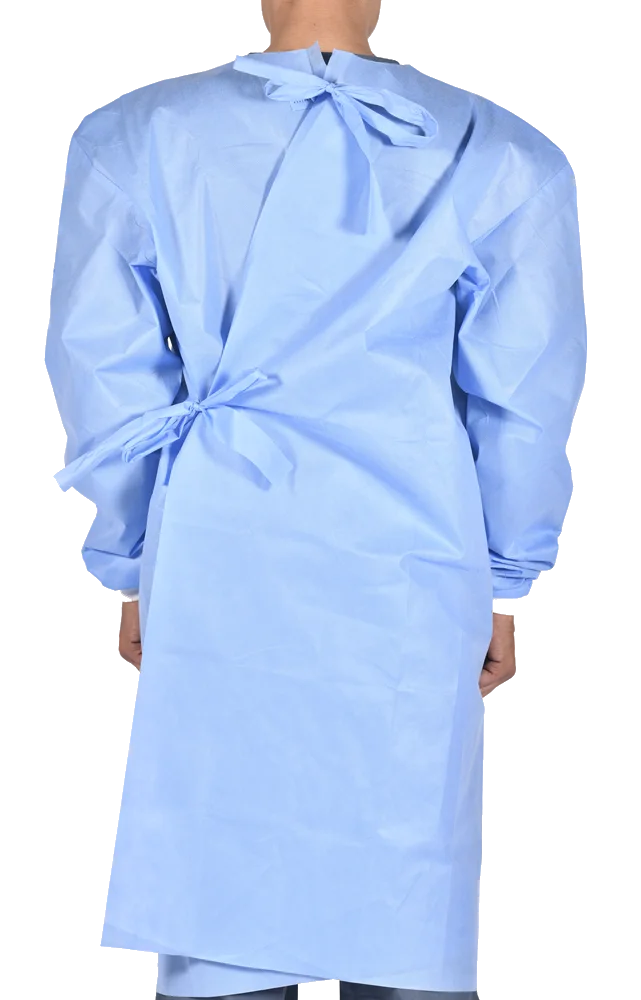
| Closure | Neck fastening and waist ties, with a transfer card for sterile tying | Simple neck and waist ties; designed for self-donning |
| Packaging | Individually packed, sterile-wrapped, often with hand towels | Bulk packed, typically several to a bag |
| Sizing and cut | Graded sizes; generous sleeve and length for reach | Often one or two sizes; looser general fit |
Construction details that follow from the purpose
Several smaller design features trace back to the same logic.
- Folding. A surgical gown is folded inside out in a specific pattern so that the scrubbed wearer can pick it up by the inner surface and let it unfold without touching the outside. Isolation gowns are simply folded flat.
- Ties and transfer card. The outer waist tie of a surgical gown is attached to a card that a circulating nurse can hold while the wearer turns, so the wrap closes without contaminating the tie.
- Seams. Sleeve seams on surgical gowns sit in a critical zone and may be welded, sealed or taped. On isolation gowns, seams anywhere on the body count towards the barrier claim.
- Removal. Isolation gowns are designed to come off quickly and safely, and some have a neck that tears away so the gown can be pulled off forwards and rolled inside out.
- Linting and cleanliness. Low particle release is a specific requirement for products used at the wound, and is part of what standards such as EN 13795 assess for surgical gowns.
Standards and regulatory treatment
AAMI PB70 covers both gown types and uses the same four barrier levels for each, differing in how the critical zone is defined. EN 13795 applies to surgical gowns, drapes and clean air suits used in the operating theatre and is not written for isolation gowns. In India, IS 17334:2019 addresses surgical gowns and surgical drapes.
Regulators may also classify the two products differently, and the route to market for a sterile surgical gown is generally more demanding than for a non-sterile cover gown. Requirements vary by country and change over time, so importers and hospital buyers should check the current official text or consult a regulatory adviser. An overview of the standards we work with is on our quality and certifications page.
Which gown belongs where
Hospital protocol decides, but the general pattern is consistent:
- Operating theatre, scrubbed team: sterile surgical gown, standard or reinforced according to the procedure.
- Wards, ICU, emergency and dialysis under contact precautions: isolation gown at a barrier level matched to the expected fluid exposure.
- Laboratories and pathology: isolation gowns or laboratory coats, according to the hazard assessment.
- Visitors and non-clinical staff entering restricted areas: light cover gowns or other disposable apparel.
An isolation gown should not be used in place of a surgical gown at the operating table: it is not sterile and is not designed for aseptic donning. The reverse substitution is safe but wasteful, since the sterile packaging and tailored construction add cost that ward use does not need.
Getting the specification right
Most mix-ups are avoided by writing five things into every gown requisition: the gown type, sterile or non-sterile, the barrier standard and level, the size range, and the pack format. Ask suppliers to state clearly which areas of the garment their barrier claim covers, and request samples so that nursing staff can check donning, coverage at the back and ease of removal.
Shrisay Medical manufactures single-use surgical gowns in Faridabad, with sizes and configurations customisable to the requirement.
Frequently asked questions
Can an isolation gown be used in the operating theatre?
Not by scrubbed staff at the sterile field. Isolation gowns are generally non-sterile and are not designed for aseptic donning, so a sterile surgical gown is required.
Why is the back of a surgical gown less protective?
The wearer faces the sterile field, so fluid exposure is concentrated on the front and forearms. Keeping the back lighter improves breathability during long procedures.
Do isolation gowns use the same AAMI levels as surgical gowns?
Yes, AAMI PB70 applies Levels 1 to 4 to both, but for isolation gowns the barrier requirement extends across the whole garment rather than the front and sleeves only.