Key takeaways
- Squaring off frames the incision with four drapes and works for any site, which is why it remains in use.
- Adhesive utility drapes fix along their whole edge without piercing the barrier, but they need fully dry skin.
- A basic set adds side, head and foot sheets to cover the whole patient and form the anaesthesia screen.
- Four-drape sets suit unusual, extendable or multiple incisions; fenestrated drapes suit routine, high-volume procedures.
Squaring off is the oldest technique in draping and still one of the most useful. Four pieces of sterile material are laid around the prepared skin, one on each side, so that their edges frame a rectangle where the incision will be made. Larger sheets then extend the covered area to the head, the feet and the sides of the table. Nothing about the method depends on the operation being performed, which is exactly its strength.
The products involved are simple: utility drapes, sometimes called adhesive towels, and the plain sheets of a basic drape set. This guide explains what each is, how they compare with cloth towels and clips, and when a set of plain sheets is a better choice than a fenestrated drape designed for a single procedure. Technique is taught locally and hospital policy takes precedence over anything said here.
What squaring off achieves
The first drapes to touch the patient have a particular job. They define the boundary between prepared skin that will remain exposed and everything else. If that boundary moves during the operation, unprepared skin comes into the field. The requirements are therefore:
- a straight, clean edge that can be placed accurately;
- a means of fixing that edge to the skin so that it does not creep;
- a barrier to fluid, because this is the area closest to the wound;
- enough flexibility to follow the body’s contours without lifting.
Once a drape has been placed it is not moved towards the incision, since that would drag material from an unprepared area into the field. If it is misplaced, it is discarded or moved only outwards, in line with the usual principles of the sterile field.
Utility drapes and adhesive towels
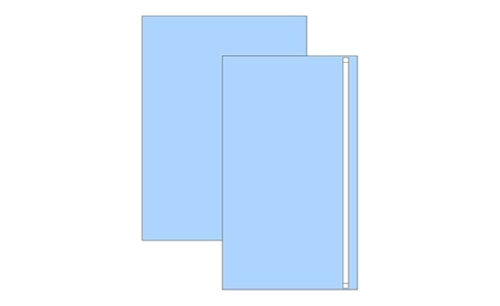
An adhesive utility drape is a small rectangular drape with a strip of skin-contact adhesive along one edge, protected by a release liner. The names “utility drape” and “adhesive towel” are used loosely and often for the same item. Where a distinction is drawn, it is usually this:
- A utility drape is typically an impervious film, or a film laminated to a non-woven, and is chosen where a waterproof seal matters.
- An adhesive towel is typically a softer, absorbent non-woven with an adhesive strip, closer in feel to the cloth towel it replaces.
Either can be used for squaring off. They are also the general-purpose patch of the theatre: isolating a stoma or a perineum, covering a groin, sealing the join between two larger sheets, wrapping a foot or fixing a tube.
Adhesive strips compared with towels and clips
The traditional method uses four folded cloth towels held at the corners with towel clips. It is still seen, but single-use adhesive drapes have largely taken its place in hospitals that use disposable drape systems. The differences are practical ones.
| Aspect | Adhesive utility drape or towel | Cloth towel with clips |
|---|---|---|
| Fixing | Adhesive strip bonds the edge to the skin along its length | Clips hold at the corners only; edges can gape between them |
| Barrier integrity | No holes are made in the drape | Penetrating clips pierce the towel and may pierce skin or underlying drapes |
| Fluid | Film or laminate types are impervious | Woven cloth can wet through unless specially treated |
| Imaging | Nothing metallic in the field | Metal clips may appear on X-ray images |
| Dependence on skin condition | Needs dry skin; adhesion is poorer on damp, hairy or oily skin | Works regardless of skin surface |
The dependence on dry skin is the main limitation of adhesive products. Antiseptic preparation has to be allowed to dry fully before the strip is applied, which is in any case necessary for the antiseptic to work and, with alcohol-based solutions, for fire safety. On very fragile skin the team may prefer a non-adhesive method.
What a basic drape set contains
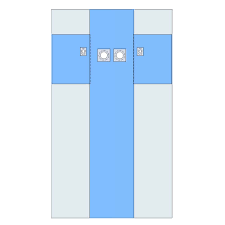
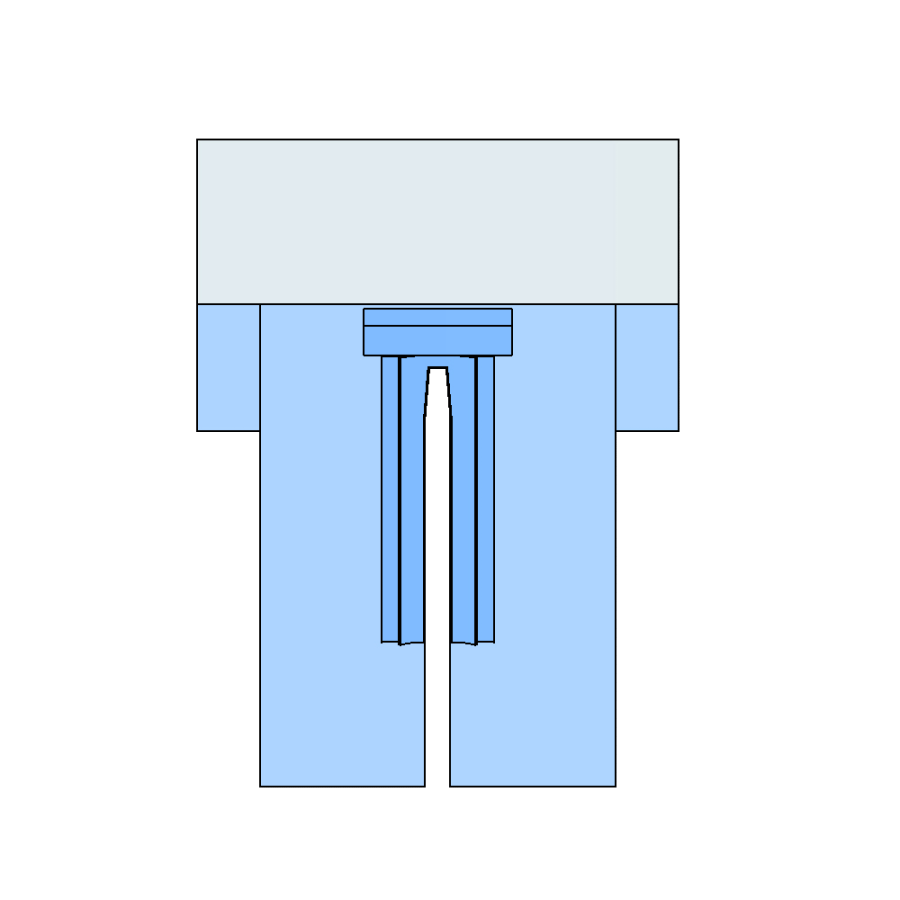
A basic or universal set extends the squared-off area to cover the whole patient and table. Contents vary between suppliers, but the usual components of a basic drape set are:
- Two side sheets, each with an adhesive edge, placed along either side of the incision.
- A foot sheet, the larger of the end sheets, with an adhesive edge, covering the lower body and the foot of the table.
- A head sheet, with an adhesive edge, covering the upper body and raised over a frame or supports to form the anaesthesia screen.
- Adhesive tape strips for securing overlaps.
- Often a table cover, a mayo stand cover and hand towels, so that the set is complete for a simple case.
The area around the adhesive edge of each sheet is commonly reinforced with an absorbent layer over an impervious backing, since that edge forms the border of the wound.
When four sheets beat a fenestrated drape
A procedure-specific drape, with its opening, reinforcement and attachments already positioned, is faster to apply and has fewer joins. For routine, high-volume operations it is usually the sensible choice. There are nonetheless clear situations in which a four-drape set serves better.
- The incision is not where a standard drape expects it. Flank, groin, chest wall, back and limb-root incisions, or any unusual site, can be framed exactly with separate sheets.
- The incision may need to be extended. In trauma or exploratory surgery the final extent of the wound is not known at the start. Squared-off sheets can be placed wide.
- More than one site is needed. Graft and flap donor sites or combined procedures may require two fields that no single fenestration fits.
- The patient is outside the usual size range. A fixed fenestration can be too large for a small child or sit awkwardly on a very large patient.
- The hospital’s case mix is broad and volumes are low. A small facility may prefer to stock one versatile set instead of many specialised drapes with slow turnover.
The trade-off is more pieces to apply, more overlaps to secure and no built-in pouch or tube holders. For operations with heavy irrigation or large fluid volumes, a purpose-designed drape with fluid collection generally remains the better option. The reasoning for either route is set out in our guide to choosing the right surgical drape for a procedure.
Specifying utility drapes and basic sets
Because these are simple products, the differences between them lie in details that are easy to miss on a data sheet:
- dimensions of each sheet, and whether they suit your tables and patient range;
- width and length of the adhesive strip, and how easily the liner peels with gloved hands;
- material of the base sheet and the size of any reinforced zone;
- the barrier standard and performance level claimed, for example under IS 17334:2019 or EN 13795-1;
- the number of utility drapes included, and the folding sequence of the set.
Shrisay Medical manufactures adhesive utility drapes and basic drape sets in Faridabad, with sheet sizes and set contents made to order; for samples or a specification, please contact our team.
Frequently asked questions
What is the difference between a utility drape and an adhesive towel?
The terms overlap. Where a distinction is made, a utility drape is usually an impervious film or laminate and an adhesive towel is a softer absorbent non-woven, each with an adhesive strip on one edge.
Why have adhesive drapes largely replaced towel clips?
An adhesive strip seals the whole edge to the skin and makes no holes, whereas penetrating clips pierce the material and hold only at the corners.
When should a basic drape set be used instead of a fenestrated drape?
When the incision site is unusual, may need extending, or involves more than one field, or when the specific drape is unavailable. The decision rests with the surgical team.