Key takeaways
- A gown’s barrier level is set by the weakest component of its critical zone, and that is often the sleeve seam instead of the fabric.
- Sewn seams are strong and versatile, but every stitch is a hole and thread can wick liquid through.
- Ultrasonic welding fuses polypropylene layers without needle holes, though its performance depends on weld pattern and process control.
- Taping over a seam seals the join and is typical of reinforced and highest-barrier gowns.
A surgical gown starts as flat pieces of fabric cut from a roll. Turning those pieces into sleeves and a body means joining them, and every join is a line along which the material has been pierced, melted or covered. Fabric data sheets describe the roll goods. The wearer depends on the finished garment, and the difference between the two lies largely in the seams.
Why a seam can be the weak point
In a sleeved gown the most important seam is the one that closes each sleeve, running from the underarm to the cuff. The forearm is the part of the wearer most likely to rest in a wet field, and it does so under pressure. A seam in that position is challenged by fluid, by mechanical strain as the arm bends, and by time.
Barrier standards recognise this. Under ANSI/AAMI PB70 a gown is classified by the lowest-performing component of its critical zone, and seams within that zone are among the components considered. European and Indian standards likewise assess the finished product in its critical areas. A sleeve made of high-barrier fabric joined by a seam that leaks at low pressure takes the lower result. Our guide to AAMI PB70 Levels 1–4 sets out the classification.
Sewn seams
Stitching with needle and thread is the oldest way to join fabric and still has real advantages: it is strong, it tolerates flexing, it works on any material, and it is the natural way to attach a knitted cuff or a tie. Its limitation as a barrier is simple. Each stitch is a hole, and a sewn seam is a row of them. The thread fills each hole only partly, and thread can itself draw liquid through by wicking.
Manufacturers reduce the problem in several ways:
- folding the seam so that the stitch line is buried between layers rather than exposed on the surface;
- using fine needles and a stitch density chosen to limit the number and size of holes without weakening the seam;
- positioning the sleeve seam towards the back of the arm, away from the inner forearm;
- covering the stitched seam with tape, as described below.
A plain sewn seam can be entirely appropriate where exposure is low, and it remains common in gowns intended for lower barrier levels and in the less critical parts of any gown.
Ultrasonically welded seams
Polypropylene, the polymer behind spunbond and SMS non-wovens, is a thermoplastic: it softens and flows when heated and sets again on cooling. Ultrasonic welding takes advantage of this. The two layers are pressed between a vibrating tool, called a horn or sonotrode, and a patterned anvil. High-frequency mechanical vibration generates heat by friction within the material, the fibres melt at the points of contact, and the layers fuse. No needle, thread or adhesive is involved.
For a barrier garment the gain is that there are no stitch holes and no thread to wick. The process is also fast and leaves a flat, clean seam. It has limits of its own:
- Process sensitivity. Too little energy gives a weak bond that peels apart; too much thins or perforates the fabric along the weld line, creating exactly the leak path the process was meant to avoid.
- Bond pattern. A weld made of separate dots or dashes is strong and flexible but leaves unbonded channels between the points. A continuous weld line gives a better seal. The pattern matters as much as the method.
- Material compatibility. Welding works on thermoplastic non-wovens and films. It is not suitable for cellulose-based fabrics, and knitted cuffs are normally sewn on.
- Strength under peel. A welded seam can be weaker than a sewn one when the layers are pulled apart, so seam design and width need attention.
The structure of the fabrics being joined is described in our article on SMS, SMMS and SMMMS non-wovens.
Taped and sealed seams
For the highest barrier levels, the seam is covered. A strip of tape, typically a film or film-laminate with a heat-activated adhesive, is applied over the seam line with heat and pressure so that it bridges the join and seals any holes beneath it. The seam underneath may be sewn, welded or both; the tape provides the barrier and the underlying seam provides the strength.
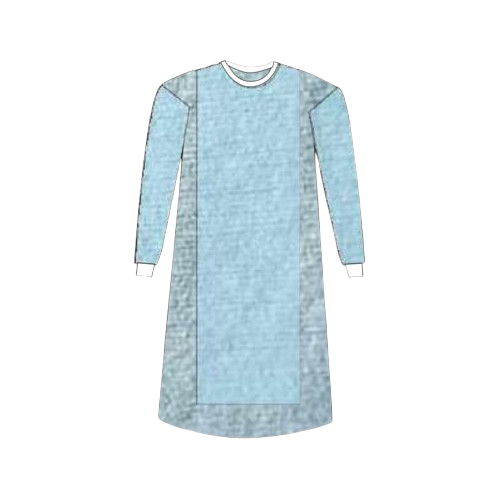
Taping is most often seen on the sleeve seams of reinforced gowns and of gowns claiming the highest liquid and viral barrier, where the fabric in the critical zone is itself a film laminate. It adds cost, a processing step and some stiffness along the seam. Its own points of failure are worth knowing: tape that is not fully bonded can lift at the edges, and the ends of the tape near the cuff and underarm need to be finished cleanly. The article on standard versus reinforced surgical gowns explains where the extra layer sits.
The three constructions compared
| Seam type | How it is made | Barrier behaviour | Typical use |
|---|---|---|---|
| Sewn | Needle and thread, often folded | Stitch holes and thread can let liquid pass under pressure | Lower barrier levels; cuffs, ties and less critical areas |
| Ultrasonically welded | Vibration melts and fuses thermoplastic layers | No stitch holes; depends on weld pattern and process control | Sleeve and shoulder seams of polypropylene gowns |
| Sewn or welded, then taped | Seam covered by a heat-applied sealing tape | Seam line sealed; depends on tape adhesion | Sleeve seams of reinforced and highest-barrier gowns |
| Welded reinforcement panel | Extra layer bonded over chest or forearm | Bond line is a join in the critical zone and is assessed with it | Reinforced gowns |
Seams are not the only joins. The edge where a reinforcement panel is bonded to the base fabric, and the point where a tie is attached to the front of the gown, are also interruptions in the barrier. The article on the critical zones of a surgical gown covers these in more detail.
What to ask and what to look at
When a supplier states a barrier level, a few questions establish whether the seams are included in the claim:
- How is the sleeve seam constructed, and is it the same on every size?
- Does the test report cover the seam as well as the base fabric and reinforcement, and which test methods were used?
- Was the testing done on finished, sterilised gowns or on material samples?
- What in-process checks are made on weld or tape quality during production?
A sample can also be examined directly. Turn a sleeve inside out and look along the seam for skipped stitches, burn-through, gaps in the weld or lifting tape. Pull gently across the seam to see whether it opens. These simple checks do not replace laboratory testing, but they quickly show whether the seam has been made with care, and whether one sample matches the next.
Shrisay Medical manufactures standard and reinforced surgical gowns in Faridabad, made to order for hospitals, distributors and export buyers.
Frequently asked questions
Are sewn seams unacceptable in a surgical gown?
No. Sewn seams are suitable where fluid exposure is low and are normal for cuffs, ties and less critical areas. For higher barrier levels the sleeve seam is usually welded, taped or both.
Why does ultrasonic welding suit polypropylene gowns?
Polypropylene is a thermoplastic, so it melts and fuses under the heat generated by ultrasonic vibration. The layers bond without stitch holes, thread or adhesive.
How can I tell whether the seam was included in a barrier claim?
Ask for the test report and check that it lists the seam among the components tested, along with the test methods and whether finished, sterilised gowns were used.