Key takeaways
- An incise drape is a transparent adhesive film through which the surgeon cuts, keeping skin covered to the wound edge.
- Its practical benefits are fixing the surrounding drapes and keeping the field dry; its effect on infection rates is not clearly established.
- Film that lifts at the wound edge defeats the purpose, so dry skin and careful application matter more than the brand.
- Whether to use plain film, antimicrobial film or none is a decision for hospital infection control policy.
Most surgical drapes work by covering everything except the operative site. An incise drape does the opposite: it covers the site itself. It is a thin, transparent, adhesive-backed plastic film applied to the prepared skin, and the surgeon makes the incision straight through it. Incise films are among the most debated items in the draping set, so it is worth being precise about what they can and cannot be expected to do.
What an incise drape is made of
The film is usually polyurethane or a similar polymer, thin enough to conform to body contours and to stretch slightly as tissue is retracted. One face carries a pressure-sensitive acrylic adhesive protected by a release liner; many designs add a non-adhesive handle or paper frame at each end so that two people can hold the film taut without touching the adhesive. Polyurethane films are generally permeable to moisture vapour, which helps to limit sweat collecting underneath during a long case.
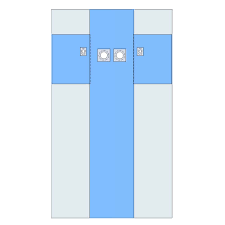
Incise film is supplied in two ways. As a separate sheet, in a range of sizes, it is applied after the main drapes. As an integrated window, it is built into the fenestration of a procedure drape, so the film and the drape go on in one step. Integrated windows are common in caesarean, orthopaedic and ophthalmic drapes.
What it is intended to do
- Cover skin up to the wound edge. Antiseptic preparation reduces skin flora but does not remove organisms living deeper in hair follicles and glands. The film is intended to hold whatever remains on the skin beneath it rather than leave bare skin beside the incision.
- Fix the surrounding drapes. Applied over the edges of the fenestration or the squared-off sheets, the film locks the field together and removes the need for towel clips.
- Seal off difficult areas. It can isolate a stoma, a nearby drain site, the groin or perineum from the working area.
- Keep the drape edge dry. Fluid runs over the film onto the drape or into a pouch rather than tracking underneath onto unprepared skin.
- Hold marking and landmarks in view. Being transparent, it leaves skin marks and anatomy visible.
Plain and antimicrobial films
| Feature | Plain incise film | Antimicrobial incise film |
|---|---|---|
| Construction | Polymer film with acrylic adhesive | The same, with an antiseptic agent in the adhesive, most commonly an iodophor |
| Intended action | Physical cover and fixation only | Physical cover plus antiseptic contact with the skin beneath |
| Main caution | Adhesive sensitivity; lifting at the edges | As for plain film, plus contraindication in patients with iodine sensitivity where an iodophor is used |
| Typical position in policy | Varies; some guidance advises against routine use | Varies; some guidance prefers it where a film is used at all |
What the evidence does and does not show
It would be convenient to say that incise drapes reduce surgical site infection. The published evidence does not clearly support that statement. Systematic reviews of clinical trials have not shown that plain adhesive films lower infection rates, and international and national guidelines have, in broad terms, been cautious: some advise against using incise drapes for the purpose of preventing infection, while others accept antimicrobial-impregnated film where a surgeon wishes to use one. Recommendations differ between bodies and are updated periodically.
Two practical conclusions follow. First, an incise film should be chosen for what it reliably does, which is to fix drapes, isolate nearby contaminated areas and manage fluid, rather than as an infection-prevention measure in its own right. Second, the decision to use one, and which type, belongs in the hospital’s infection control policy and should be reviewed against current guidance. A supplier’s role is to provide a film that adheres properly and is safe on skin, not to make clinical claims for it.
Where it fits in the draping sequence
The exact order depends on the drape system and on local protocol, but a typical sequence with a separate incise sheet is:
- Skin is prepared with antiseptic and allowed to dry completely for the time stated by the prep manufacturer.
- The main drapes are placed: either four adhesive-edged sheets squared around the site, or a fenestrated procedure drape.
- The incise film is opened, the liner is peeled back, and the film is held taut above the site by two members of the scrubbed team.
- It is lowered onto the skin and smoothed outwards from the line of the incision with a sterile swab or towel, overlapping the edges of the surrounding drapes.
- The incision is made through the film.
With an integrated window, steps two to four are combined. At the end of the case the film is peeled back slowly, close to the skin surface, to limit skin stripping. In either case the manufacturer’s instructions for use take precedence.
Common application problems
- Wet skin. Adhesive does not bond to damp prep solution. Pooled alcohol-based prep trapped under a film is also a fire hazard with diathermy.
- Lifting at the wound edge. If the film separates from the skin during surgery, fluid and organisms can collect beneath it at exactly the point it was meant to protect. This is the failure that matters most.
- Wrinkles and air channels. Creases create paths for fluid to track. Tension during application and smoothing from the centre outwards reduce them.
- Hair and skin folds. Both prevent a continuous bond and may call for a different approach.
- Wrong size. The film should extend well beyond the planned incision and any likely extension.
- Skin injury on removal. Fragile skin in elderly patients and neonates needs particular care.
What to ask before specifying an incise film
For procurement and theatre teams, the useful questions are practical ones:
- What does our infection control policy say about incise drapes, and for which procedures?
- Do we want a separate film, or a window integrated into the procedure drape?
- What sizes cover our usual incisions with a margin?
- How does the film behave in a trial: adhesion through a long case, clarity, ease of handling, residue on removal?
- What biocompatibility and sterilisation information can the supplier provide?
Shrisay Medical supplies drapes with fenestrations and windows configured to the hospital’s specification and can include the agreed components in customised kits and packs; our quality page describes the documentation available.
Frequently asked questions
Is an incise drape the same as a surgical drape?
It is one type of surgical drape. Unlike a sheet that surrounds the site, an incise drape is a thin adhesive film placed directly over the prepared skin, and the incision is made through it.
Do incise drapes prevent surgical site infection?
The evidence does not clearly show that they do, and guidance from different bodies varies. They are best valued for fixing drapes and managing fluid, with clinical use decided by hospital policy.
Why must the skin be dry before applying an incise film?
The adhesive will not bond properly to wet skin, so the film may lift during surgery. Alcohol-based prep trapped beneath a drape is also a fire risk when diathermy is used.