Key takeaways
- Standard precautions apply to all patients, and a gown or apron is worn whenever soiling or splashing with body fluids is anticipated.
- Body covering is central to contact precautions, while droplet and airborne precautions are defined mainly by respiratory protection.
- The choice between apron and long-sleeved gown depends on forearm contact, fluid volume, duration and the organism, as local policy sets out.
- Disposable gowns and aprons are single-use, removed before leaving the patient area and discarded as bio-medical waste where contaminated.
A coloured sign on a side-room door reads “contact precautions”. A nurse about to go in has a few seconds to decide what to put on, and the trolley outside holds plastic aprons, non-woven aprons and long-sleeved isolation gowns. The sign names the route by which the infection spreads. It is the hospital’s infection control policy that translates this into a particular garment, and understanding the logic behind the policy makes it easier to follow and easier to stock for.
This article sets out that logic in general terms. It does not replace local policy, which takes account of the organism, the patient, the task and current national guidance.
Standard precautions come first
Standard precautions apply to every patient, in every setting, whether or not an infection has been diagnosed. They rest on the assumption that blood, body fluids, secretions, excretions, non-intact skin and mucous membranes may carry transmissible organisms. Hand hygiene is their foundation. Protective equipment is added according to the exposure expected from the task, not the diagnosis.
For body covering, the principle is straightforward: a gown or apron is worn when clothing or skin is likely to be soiled or splashed with blood or body fluids. Emptying a drain or cleaning up a spill calls for protection under standard precautions alone.
Transmission-based precautions
Where a patient is known or suspected to have an infection that standard precautions will not contain, a second tier is added according to the route of spread. The three categories are used alone or in combination.
| Category | Route of spread | Body covering usually specified | Other key measures |
|---|---|---|---|
| Standard | Assumed risk from blood and body fluids in all patients | Apron or gown when splash or soiling is anticipated | Hand hygiene; gloves, mask and eye protection by task |
| Contact | Hands, clothing, surfaces and equipment touched by or near the patient | Gown or apron for contact with the patient or the surroundings, as policy states | Gloves; dedicated equipment; room cleaning |
| Droplet | Larger respiratory particles travelling a short distance | As for standard precautions, based on expected splash or contact | Surgical mask; eye protection; patient placement |
| Airborne | Fine particles that remain suspended and travel further | As for standard precautions, unless policy for the organism says otherwise | Respirator; ventilated isolation room |
The table shows something that is easy to miss. Body covering is the defining item of personal protection for contact precautions. For droplet and airborne precautions the defining item is respiratory protection, and the gown or apron is chosen by the same splash-and-contact reasoning as under standard precautions. Policies for particular high-consequence infections go further and specify full body cover, but those are organism-specific protocols and not the general rule.
Gown or apron
Guidance differs between countries on this point. Some frameworks call for a long-sleeved gown for every entry to a contact-precautions room. Others accept a disposable apron for routine contact and reserve gowns for more extensive exposure. Indian hospitals will find both approaches in use, and the facility’s own policy, informed by national guidelines on infection prevention and control, settles the matter.
The reasoning behind the choice turns on a few questions.
- Are the forearms likely to be contaminated? An apron protects the front of the uniform only. Lifting, turning and washing a patient bring the arms into contact, which favours sleeves.
- How much fluid is expected? Light contact needs a simple covering. Heavy splashing, an uncontained wound or profuse diarrhoea calls for a fluid-resistant or impervious garment.
- How long and how close is the contact? A brief observation round differs from an hour of personal care.
- How readily does the organism persist on surfaces and fabric? For some organisms the policy will specify a gown regardless of the task.
The garments on the trolley
- Plastic apron. Impervious, inexpensive and quick to put on, but sleeveless and warm to wear. Suited to short tasks with limited contact.
- Non-woven apron. More comfortable than plastic film and available in fluid-repellent grades; still sleeveless. See our disposable non-woven aprons.
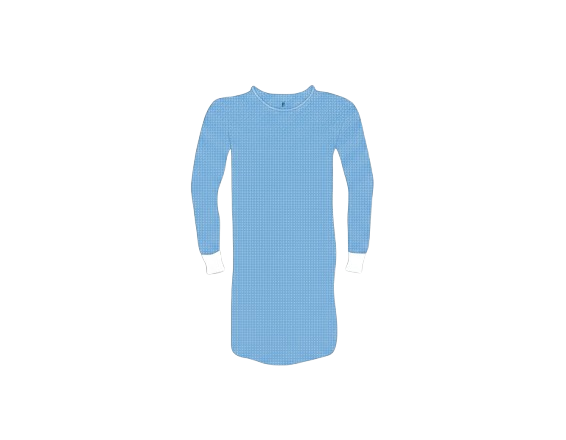
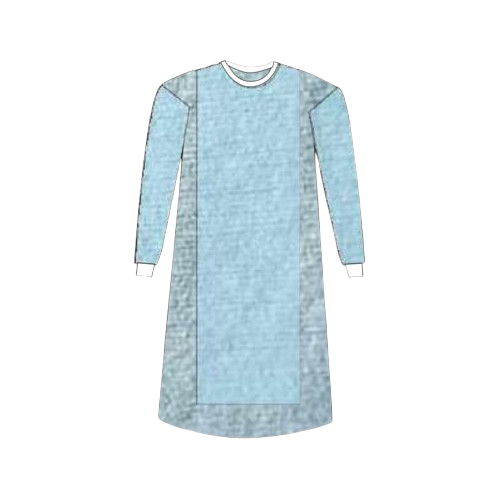
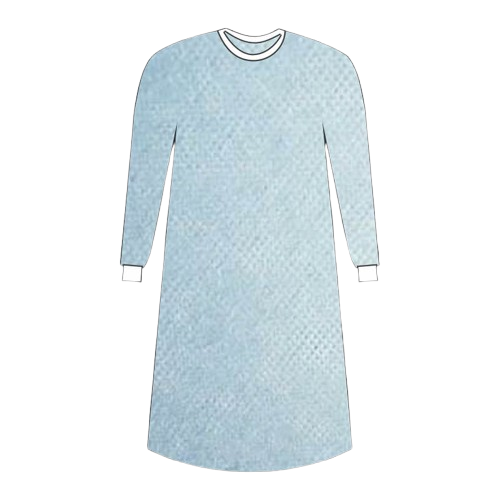
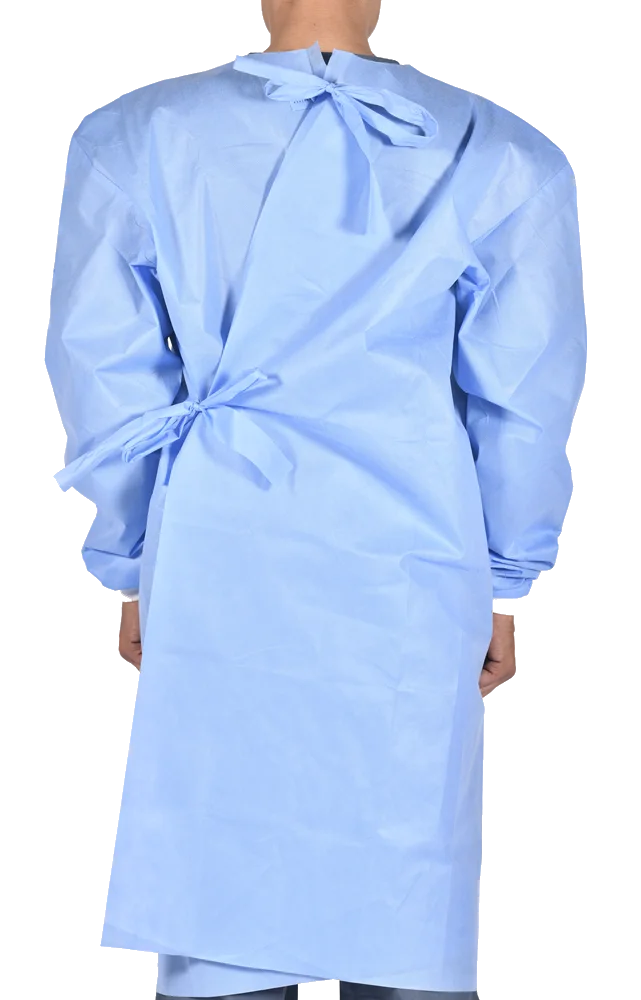
- Isolation gown. Long sleeves with cuffs, full front and usually back coverage, tied at neck and waist. Non-sterile, and the usual choice where arms and clothing need protection.
- Sterile surgical gown. Required for surgical and other aseptic procedures; its purpose is the sterile field as much as the wearer.
The construction differences between the last two are explained in our comparison of surgical and isolation gowns. An isolation gown’s barrier level should match the fluid exposure; a light SMS isolation gown is appropriate for routine contact but not for heavy, sustained wetting.
Extended exposure and repeated entry
Staff in an isolation or cohort area may wear protective clothing for long periods, or enter the same room many times in a shift. Two practical issues follow.
The first is comfort. A garment that is too hot will be adjusted, opened at the back or removed early, so breathable non-woven gowns are better tolerated over several hours.
The second is the single-use principle. A disposable gown or apron is intended for one episode of care with one patient. It is removed before leaving the patient’s area and is not hung up for the next entry. Whether a gown may be worn across several patients in a cohort bay during a period of shortage or outbreak is a decision for the infection control team, made explicitly, and not a habit to drift into.
Doffing and disposal
More self-contamination occurs while taking protective clothing off than while wearing it. The outside of the gown, particularly the front and sleeves, is treated as contaminated. The sequence is defined by local policy and should be displayed where staff remove their equipment. The common elements are these:
- Remove gloves and gown or apron inside the room or in the designated area, before touching anything clean.
- Break or untie the fastenings without pulling the garment over the head.
- Peel the gown away from the neck and shoulders, turning it inside out and rolling it into a bundle with the contaminated surface inwards.
- Place it directly in the correct waste container without pressing it down by hand.
- Perform hand hygiene immediately, and again after removing any mask or respirator.
Used gowns and aprons contaminated with blood or body fluids are bio-medical waste and are segregated according to the Bio-Medical Waste Management Rules 2016 and the hospital’s authorisation. The categories and handling are covered in our article on the disposal of used drapes and gowns.
Stocking for the policy
For purchase managers, the policy translates into a short list: an apron for brief, low-contact tasks, an isolation gown in the sizes staff need, and a higher-barrier gown for fluid-heavy care, all kept at the point of use outside isolation rooms.
Shrisay Medical manufactures isolation gowns, surgical gowns and disposable aprons in Faridabad for hospitals and distributors; to match a range to your precaution policy, please contact us.
Frequently asked questions
Is a gown always required for contact precautions?
It depends on the policy your hospital follows. Some guidance requires a long-sleeved gown for every room entry; other guidance permits an apron for limited contact and a gown for more extensive exposure.
Do airborne precautions require a special gown?
Not in general. Airborne precautions centre on a respirator and a suitable isolation room, with a gown or apron chosen by the expected contact and splash, unless the policy for a specific organism requires more.
Can a disposable isolation gown be reused for the same patient?
Disposable gowns are intended for a single episode of care and are removed before leaving the patient area. Any departure from this, for example during shortages, is a decision for the infection control team.